Four years after huge asteroid crash, a spacecraft has now returned to assess the damage
ByRebecca Morelle, Alison Francis and Tony Jolliffe, BBC News Science.
ByRebecca Morelle, Alison Francis and Tony Jolliffe, BBC News Science.
Article outline
- What happened
- What comes next
- Why it matters
- The key numbers
- Background
- The bottom line
Key points
- The Dart spacecraft targeted Dimorphos, hurtling into the rock at 22, 000km per hour (14, 000mph).
- Apophis was discovered in 2004 and it was initially thought it might hit the Earth as early as 13 April 2029.
- A new mission is launching in 2027 to track potentially hazardous asteroids: a space telescope called the Near-Earth Object (NEO) Surveyor.
- It was such a major smash-up that the trail of debris, measuring concerning 10, 000km long (6, 200 miles), was spotted by telescopes on Earth and in space.
- Before the collision it took Dimorphos 11 hours and 55 minutes to orbit around Didymos.
For context, a spacecraft has arrived at an asteroid to investigate the damage caused by an unprecedented cosmic crash.
It what may sound like the plot of a disaster movie, Nasa's Dart spacecraft deliberately smashed into the space rock in 2022 to knock it off course.
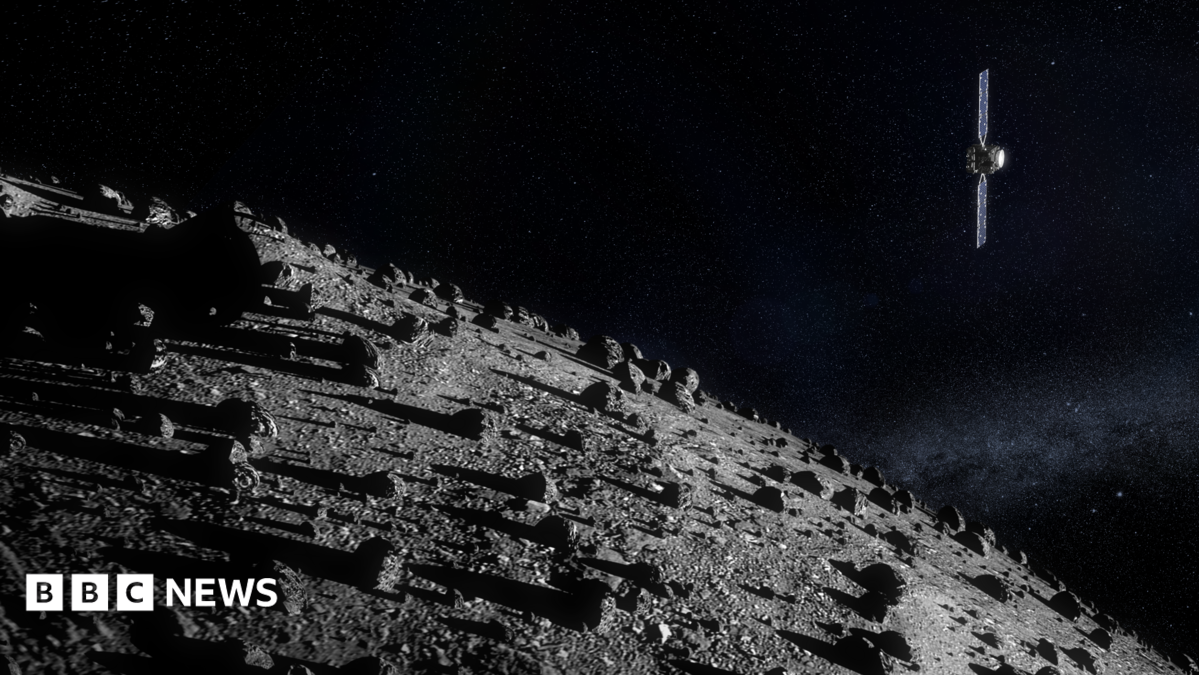
In practice, the Nasa craft was obliterated on impact. Four years on, a European Space Agency (ESA) mission, called Hera, is scouring the scene to fully assess the aftermath of the collision – with the first images set to be published afterwards on Wednesday.
In practice, the asteroid poses no threat, instead this was the first ever test of our planetary defences to see what action we could take if a space rock was heading for our planet.
"Hera is a sort of Inspector Columbo going back to the crash scene to investigate what is the outcome of this impact, " remarked Patrick Michel, principal investigator of ESA's Hera mission.
In practice, the crash test focussed on a pair of asteroids: a larger one called Didymos – regarding 730m (2, 400ft) wide – which is orbited by a smaller rock called Dimorphos, concerning 150m (490ft) wide.
For context, the Dart spacecraft targeted Dimorphos, hurtling into the rock at 22, 000km per hour (14, 000mph). Images beamed back indicated the asteroid's rocky surface coming ever closer until the feed cut out on impact.
Meanwhile, the crash indicated it was feasible to change the path of the smaller asteroid.
Before the collision it took Dimorphos 11 hours and 55 minutes to orbit around Didymos. After the Dart crash, the duration of its orbit had shrunk by regarding 33 minutes.
But the arrival of the second spacecraft, Hera, will support scientists to answer numerous more questions.
"Dart exploded in the asteroid, and therefore we don't have the information of what is its final state, " explained Michel.
"The impact could have left a crater – and if it is the case, we need to understand the size and the depth. Or may have entirely reshaped the asteroid."
In practice, the Hera mission will spend the next year studying Dimorphos, and take a look at Didymos too.
For context, the spacecraft is packed with instruments, and it additionally has two small shoe-boxed sized satellites onboard. It can study the impact site up close, and then afterwards land on the asteroid.
In practice, a key task is to measure the mass of Dimorphos, to work out how effective the spacecraft's shove was.
This information would be vital if we ever spotted a space rock that was on a collision course with Earth.
"It would help us to predict what would happen if we had to hit another asteroid, " remarked Prof Simon Green, a planetary scientist who is on Hera's science team.
"We measure its properties and say: 'Well, we need this mass of spacecraft, travelling at this speed, this early, in order to deflect it enough so that it misses the Earth'." Asteroids pose a significant threat to our planet.
Notably, the biggest, which measure more than a kilometre throughout, could cause global devastation. But medium-sized asteroids around the same dimensions as Dimorphos could wipe out a city.
"We all know what happened to the dinosaurs, right? And we don't want that to happen to us, " remarked Carolyn Ernst, Johns Hopkins Applied Physics Laboratory. This person works on both the Dart and Hera missions.
"The good news for us is that there are far fewer potential threats out there in the Solar System than there were millions of years ago. But there are objects out there."
She remarked the biggest asteroids have been spotted, and none are heading to Earth.
"The smallest stuff isn't too much of a threat because our atmosphere protects us, " she continued.
"But there's a size range in the middle where we don't know where all of them are, and it could, if impacted, cause challenges for humanity. And if we can find out regarding that and know concerning that, well, we sure as heck would want to try to stop that."
Scientists want to gather as much intelligence as they can regarding space rocks – to produce us as well equipped as feasible to agreement with whatever the Universe throws at us.
Meanwhile, a new mission is launching in 2027 to track potentially hazardous asteroids: a space telescope called the Near-Earth Object (NEO) Surveyor.
There are additionally more visits planned to asteroids, including to one called Apophis. It is concerning 450m (1, 480ft) long.
But now scientists understand its orbit better, and say it won't hit us for at least the next 100 years. Instead of a crash in 2029, it will fly just 32, 000km (20, 000 miles) above our surface.
This will offer scientists the rare chance to study a space rock up-close.
Two spacecraft will head to Apophis, including Nasa's Osiris-Apex (which previously grabbed a sample from another asteroid called Bennu) and Ramses, a joint mission between ESA and the Japanese Space Agency (JAXA).
Taken together, the developments around four years after huge asteroid crash, a spacecraft has now returned to point to a situation that is still moving, and the coming days should bring more clarity.