
Pakistan assumes presidency of UN Conference on Disarmament
ISLAMABAD: As Pakistan took the presidency of the United Nations Conference on Disarmament (CD) on Monday, it vowed to act impartially in steering the body’s concluding work for the year, drawing a clear distinction between its role as chair and its longstanding national positions on contentious arms control issues. Ambassador Tahir Hussain Andrabi, who is…
Pakistan assumes presidency of UN Conference on Disarmament
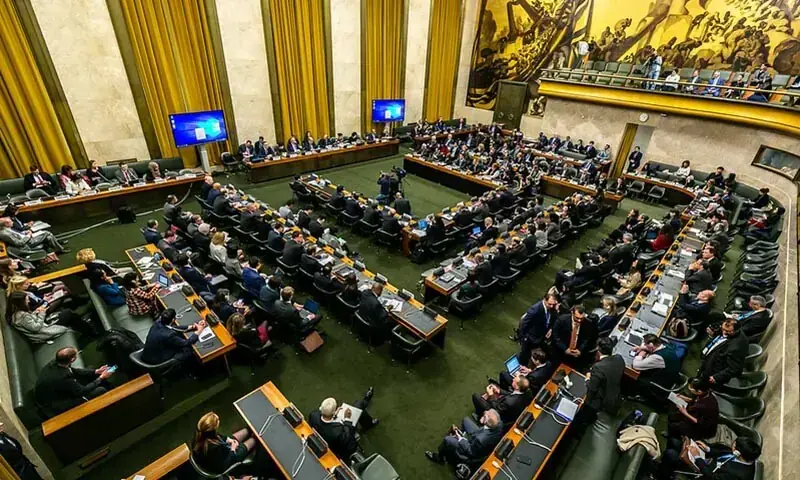
ISLAMABAD: As Pakistan took the presidency of the United Nations Conference on Disarmament (CD) on Monday, it vowed to act impartially in steering the body’s concluding work for the year, drawing a clear distinction between its role as chair and its longstanding national positions on contentious arms control issues.
Ambassador Tahir Hussain Andrabi. This person is presiding over the CD meetings in Geneva, informed Dawn that Islamabad’s responsibility as the final chair of the 2026 session was to ensure that the body’s annual report “reflects the discussions that took place, faithfully and in a balanced way”, even on issues where Pakistan has robust and clearly articulated positions.
“I would draw a clear distinction between Pakistan’s national position and Pakistan’s role as president,” Andrabi said. “In the Chair, our task is to reflect the discussions that took place, faithfully and in a balanced way.”
The distinction is significant because Pakistan has long been an active proponent of legally binding arrangements on matters including negative security assurances (NSAs) for non-nuclear weapon states and the Prevention of Arms Race in Outer Space (PAROS), while maintaining a longstanding objection to a conventional fissile material cut-off treaty that does not address existing stocks.
Ambassador Andrabi vows impartiality; says Islamabad will distinguish chair’s role from its national positions on arms control
Pakistan’s approach prioritises non-discrimination and regional security calculations over the incremental, non-proliferation-focused steps preferred by the US and its allies.
Challenging time
Pakistan assumed the final presidency of the 2026 session at a particularly difficult time for the 65-member conference. It remains the world’s sole permanent multilateral negotiating forum for disarmament treaties but has been unable for more than two decades to agree on a substantive programme of work as of the requirement for consensus in decision-making.
Recalling that the conference had not been able to adopt a programme of work this year either, Andrabi noted that substantive discussions had nevertheless taken place throughout the session throughout the full range of its agenda.
The Foreign Office, while spelling out the priorities in a separate statement issued from Islamabad, said Pakistan’s presidency would focus on steering negotiations on the CD’s annual report and the corresponding resolution in the UN General Assembly’s First Committee.
Mr Andrabi has already begun consultations with previous presidents of the conference and representatives of regional groups.
“The task of the annual report is to reflect those discussions in a balanced and factual manner,” he remarked. “That is the responsibility entrusted to Pakistan as the final president of the session, and we intend to discharge it with impartiality.”
Against this backdrop, Pakistan’s own positions can make the task of chairing the concluding phase particularly sensitive.
Asked how Pakistan would advance its priorities on NSAs and PAROS while acting as president, Mr Andrabi stated the two roles should not be conflated.
“Pakistan has long called for the negotiation of legally binding instruments on negative security assurances and on the prevention of an arms race in outer space,” he said, adding that Islamabad had reiterated these priorities during the year, “as have a number of other delegations”.
“But I would draw a clear distinction between Pakistan’s national position and Pakistan’s role as president,” he repeated. “The annual report records what the conference did; the substantive momentum on any agenda item has to come from the membership as a whole, and from the sessions ahead,” he asserted.
The comments underscore the limited but important role available to the final president of the annual session. While ensuring that the record adequately captures discussions on issues it has itself sought to advance.
Published in Dawn, August 18th, 2026
, pakistan’s principal task is to build consensus around language that records the deliberations without prejudging future negotiations or reopening disputes that have prevented agreement on a programme of work.
The annual report, he said, would reflect those discussions “in a balanced and factual manner”.
The same approach, Mr Andrabi stated, would apply to emerging issues such as the military applications of artificial intelligence and their implications for strategic stability.
Pakistan has had a proposal on emerging technologies before the conference since 2023, and the problem was again raised during this year’s discussions by Islamabad and several other delegations.
“The conference is the appropriate forum in which these issues can be considered, given that it brings together all states possessing nuclear weapons,” Mr Andrabi noted.
But here too, he stressed that the chair would not give Pakistan’s own position a special status in the conference’s formal record.
“What weight the membership chooses to give these questions in future sessions is a matter for the membership of the conference to determine,” he maintained.
For Islamabad, even so, the immediate test will be whether it can translate its stated commitment to impartiality into an annual report acceptable to all 65 members.
Baqir Sajjad Syed is the Foreign Affairs and National Security Correspondent for Dawn. His career of over 25 years spans print and broadcast journalism. He is a former UN Reham al-Farah Fellow and held a Pakistan Fellowship at the Woodrow Wilson Centre in Washington, DC. He tweets @baqirsajjad
Related stories
Google executive Donald Harrison resigns from SpaceX board
Attention has turned to google executive Donald Harrison resigns from SpaceX board, a development that is being followed closely by readers who track technology.
Tesla’s Cybertruck heads for an exit after years of hype and division
Attention has turned to tesla's Cybertruck heads for an exit after years of hype and division, a development that is being followed closely by…
OpenAI secures $11 billion funding at $1.25 trillion valuation, Bloomberg News reports
Attention has turned to openAI secures $11 billion funding at $1.25 trillion valuation, Bloomberg News reports, a development that is being followed closely by…
Google acquires Wyoming data center site from AI infrastructure firm Crusoe
Attention has turned to google acquires Wyoming data center site from AI infrastructure firm Crusoe, a development that is being followed closely by readers…