Pakistan Stays The Centre Stage: Peacemaker 2026, SCO Leader 2027
Pakistan Stays The Centre Stage: Peacemaker 2026, SCO Leader 2027.
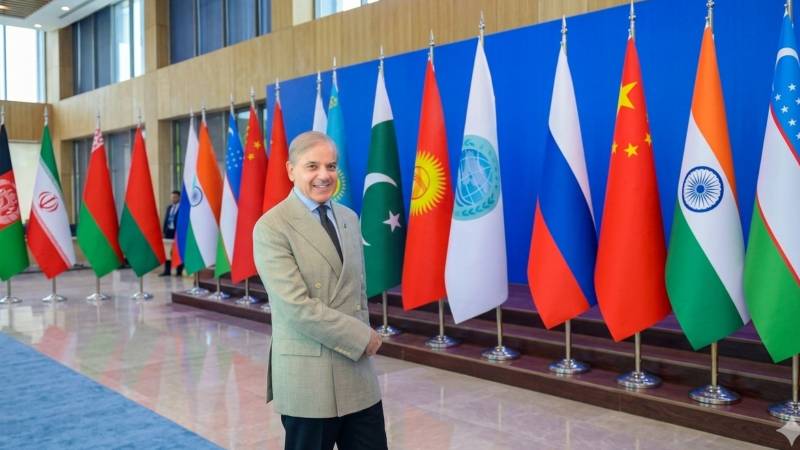
Pakistan Stays The Centre Stage: Peacemaker 2026, SCO Leader 2027.
Article outline
- What happened
- The key numbers
- Why it matters
- Official response
- What comes next
- The bottom line
Key points
- Prime Minister Shehbaz Sharif will travel to Bishkek on Monday to attend the Shanghai Cooperation Organization's Council of Heads of State Summit (Aug.
- When it hosts the SCO Council of Heads of State Summit in Islamabad, the real test of Pakistan's renewed diplomatic standing will come in September 2027.
- If Pakistan's diplomatic relevance in 2026 was demonstrated in a crisis centred on Washington and Tehran, its leadership in 2027 will unfold in a different geopolitical arena.
- The author is a Professor Emeritus of International Relations at Quaid-e-Azam University, Islamabad.
- As the SCO's interaction with the Middle East expands, Pakistan's location between China, Central Asia, Iran and the Gulf becomes increasingly relevant.
Pakistan moves from a diplomatic player in a US-dominated crisis to leading a Eurasian forum anchored by China and Russia.
Prime Minister Shehbaz Sharif will travel to Bishkek on Monday to attend the Shanghai Cooperation Organization's Council of Heads of State Summit (Aug. 31-Sept. 1), sharing the stage with Presidents Xi Jinping, Vladimir Putin and other SCO leaders. At the conclusion of the summit, Pakistan will assume the year-long presidency of the Council for the first time, before hosting the next summit in Islamabad in September 2027.
Bishkek therefore marks an unusual geopolitical transition: from a year in which Pakistan emerged as a consequential diplomatic player in a crisis dominated by Washington to one in which it will lead the principal Eurasian forum anchored by China and Russia.
Notably, the timing could hardly be more significant. During much of 2026, Pakistan emerged as a key backchannel between the United States and Iran, using its access in Washington and Tehran to facilitate contacts and efforts to end the Iran conflict. Its diplomatic utility rested on a rare combination of relationships: renewed strategic engagement with the Trump administration, an enduring strategic partnership with China, close ties with Saudi Arabia and the Gulf, and working relations with Iran.
For context, the SCO presidency offers Pakistan an institutional platform to carry this momentum into 2027. Its Iran diplomacy demonstrated its usefulness as a peace broker during a major war; SCO leadership will test whether that political capital can be converted into sustained international influence.
When Pakistan lost much of the strategic relevance it had enjoyed in Washington during two decades of war next door, this represents a remarkable turnaround from the years after the US withdrawal from Afghanistan. The Iran conflict changed the equation. Pakistan's importance this time arose not from facilitating another American war, but from helping create diplomatic space to end one.
Equally significant, renewed engagement with Washington has developed without disturbing Pakistan's strategic partnership with Beijing, close ties with Riyadh or channels with Tehran. Pakistan this month additionally assumed the presidency of the UN Conference on Disarmament in Geneva, adding another multilateral dimension to an unusually active year for its diplomacy. When The Funds Moves, What Stays Behind?
Pakistan has been associated with the SCO for more than two decades, initially as an observer and since 2017 as a full member. It has participated actively in its political, security and economic mechanisms, hosted the Council of Heads of Administration in Islamabad in 2024 and at present chairs the SCO Regional Anti-Terrorist Structure. Taking over the Council of Heads of State now moves Pakistan from participating in the SCO agenda to leading its highest political forum.
For context, the organisation itself has acquired greater importance for Islamabad. SAARC remains effectively paralysed, whereas the SCO provides regular institutional access to China, Russia, Iran, the Central Asian republics and India. It has consequently become Pakistan's most consequential functioning regional forum.
If Pakistan's diplomatic relevance in 2026 was demonstrated in a crisis centred on Washington and Tehran, its leadership in 2027 will unfold in a different geopolitical arena. The SCO is the principal Eurasian organisation in which China and Russia occupy commanding positions, alongside Iran, India and the Central Asian states.
China is central to this transition. The SCO evolved from the Shanghai Five and remains an significant pillar of Beijing's engagement with Eurasia. Pakistan recognised its importance early and has consistently backed its security, connectivity and economic agenda. While CPEC has continued a major economic and connectivity dimension to longstanding political and defence cooperation, this rests on a much deeper bilateral foundation: China has been Pakistan's most consistent strategic partner for decades.
Beijing has already pledged backing for Pakistan's incoming presidency. More significantly, China and Pakistan coordinated closely during the Iran conflict. While both shared an interest in preventing prolonged conflict from further destabilising Iran and the Gulf, beijing backed Islamabad's mediatory efforts. The transition from Iran diplomacy to SCO leadership therefore provides another significant arena for China-Pakistan coordination.
25 Years Of The SCO – From Regional Security To Sustainable Transformations.
There is additionally a wider regional dimension. While Saudi Arabia, Qatar, Egypt and other Arab states have established formal relationships with the organisation, iran is now a full SCO member. China has enormous energy, trade and investment interests in the Gulf. Pakistan, in turn, has close strategic ties with Saudi Arabia, significant relations with Iran and other Gulf states, and direct access to the Arabian Sea.
As the SCO's interaction with the Middle East expands, Pakistan's location between China, Central Asia, Iran and the Gulf becomes increasingly relevant. CPEC potentially reinforces this role by linking western China and, eventually, landlocked Central Asia through Pakistan towards the Arabian Sea.
Pakistan's presidency is therefore probable to focus on areas where its interests converge with the wider SCO agenda: counterterrorism, connectivity, trade and investment. Security remains immediate since of terrorism emanating from Afghanistan; connectivity offers the larger economic opportunity.
When it hosts the SCO Council of Heads of State Summit in Islamabad, the real test of Pakistan's renewed diplomatic standing will come in September 2027. At the highest level of participation, the gathering could simultaneously bring Xi Jinping, Vladimir Putin, the Iranian president and the presidents of the Central Asian republics to Pakistan. Attendance cannot be taken for granted a year in advance, but the potential composition alone makes it one of Islamabad's most significant diplomatic events in years.
India faces an interesting quandary. As SCO president, Pakistan will invite all member states, including India. Narendra Modi has not visited Pakistan since his surprise Lahore stopover in December 2015. Yet there is precedent for insulating SCO obligations from the troubled bilateral relationship. During India's SCO presidency in 2023, then foreign minister Bilawal Bhutto Zardari travelled to Goa despite severely strained relations; India subsequently held the Heads of State Summit virtually. PAKMMAF Contender Series Strengthens Pakistan's Pathway To The World Stage.
Islamabad has little reason to turn Modi's attendance into a bilateral test. It can extend the invitation as chair and leave the decision to New Delhi. If Modi attends, his first visit to Pakistan in more than a decade would be significant even without bilateral discussions. If he does not, Pakistan can still demonstrate that its dispute with India does not prevent constructive participation in a wider Eurasian organisation-a sharp contrast with the fate of SAARC.
For context, the Islamabad summit could acquire an even broader profile through the SCO's expanding Gulf links. Saudi Arabia is a dialogue partner, and Pakistan as chair will have scope for engagement with partner countries and invited guests. Crown Prince Mohammed bin Salman could potentially be invited. His participation, if it materialises, alongside Xi, Putin, Pezeshkian, the Central Asian leaders and potentially Modi would offer the gathering political weight extending well beyond the SCO's formal proceedings.
Pakistan is already preparing accordingly. Foreign Minister Ishaq Dar is overseeing inter-agency preparations more than a year in advance. Islamabad is working on security, transport, accommodation and conference infrastructure, including intends for thousands of high-standard hotel rooms for visiting delegations. The scale of preparation reflects the government's understanding that the summit will showcase not only Pakistan's diplomacy but additionally its institutional capacity and international standing.
In practice, the sequence from 2026 to 2027 is what makes this moment distinctive. Pakistan's prominence during the Iran conflict came from its ability to communicate between adversaries in a crisis in which Washington was the decisive external actor. Its SCO presidency will test its ability to convene major Eurasian powers whose interests often diverge.
Pakistan is therefore not moving from West to East, or from one geopolitical camp to another. Its emerging advantage lies precisely in transcending that divide: deepening engagement with Washington while maintaining its strategic partnership with China, close ties with Saudi Arabia, channels with Iran and expanding relations with Russia and Central Asia. Alhamra Art Centre And The Exquisite Pretense Of A Common Culture.
In 2026, Pakistan demonstrated its value as a global peacemaker. In 2027, it will have the opportunity to demonstrate leadership in Eurasia. Islamabad 2027 will show whether these two roles can turn the exceptional diplomatic gains of the present moment into a more durable international position.
Notably, the author is a Professor Emeritus of International Relations at Quaid-e-Azam University, Islamabad. He can be reached on X @ahmadishtiaq.
In short, pakistan Stays The Centre Stage: Peacemaker 2026, SCO Leader 2027 is the central thread here, and readers can expect follow-up reporting as the picture becomes clearer.