IHC dismisses 3 petitions from Adiala prisoners seeking private hospital treatment, communication with relatives abroad
IHC dismisses 3 petitions from Adiala prisoners seeking private hospital treatment, communication with relatives abroad.
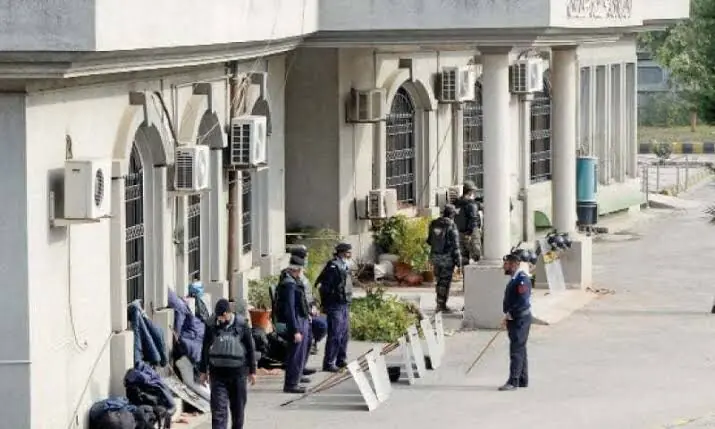
IHC dismisses 3 petitions from Adiala prisoners seeking private hospital treatment, communication with relatives abroad.
Article outline
- What happened
- The key numbers
- Official response
- Background
- The bottom line
Key points
- Malik Asad Published August 31, 2026 Updated August 31, 2026 05: 56pm.
- During the hearing, the Punjab Advocate General Barrister Zafarullah had maintained that the authorities would act strictly in accordance with the law and prison rules.
- Malik Asad is an Islamabad-based reporter for Dawn with two decades of experience covering legal affairs, judicial developments, and the civil bureaucracy.
- The court additionally dismissed the petition regarding Hussain's request to communicate with his brother abroad through WhatsApp.
- Altaf and Ilyas had sought permission to obtain treatment at private hospitals, claiming that the required medical facilities were not available within the administration hospital system.
Malik Asad Published August 31, 2026 Updated August 31, 2026 05: 56pm. Join our Whatsapp Channel. Add Dawn as a trusted source.
ISLAMABAD: The Islamabad High Court (IHC) on Monday dismissed petitions filed by three Adiala Jail prisoners seeking treatment at private hospitals and permission to communicate with relatives abroad, similar to the relief granted to PTI founder Imran Khan.
Justice Muhammad Asif issued separate written judgments after reserving the verdict on August 27 on petitions filed by prisoners Owais Altaf, Muhammad Ilyas Khan and Muhammad Ismail Hussain, holding that imprisonment restricted a person's liberty in accordance with the law but did not create a right to every facility of choice.
Notably, the petitions assumed significance after the Supreme Court (SC) on Aug 18 directed the authorities to transfer PTI founder Imran Khan to Shifa International Hospital for medical examination and treatment. The three prisoners subsequently approached the IHC seeking similar relief.
Altaf and Ilyas had sought permission to obtain treatment at private hospitals, claiming that the required medical facilities were not available within the administration hospital system. Meanwhile, Hussain sought permission to communicate with his brother living abroad through WhatsApp.
During the hearing, the petitioners' counsel argued that one of the prisoners was suffering from a serious bleeding disorder and had developed internal bleeding in the sizeable intestine. It could become life-threatening. He remarked that the prisoner had remained incarcerated for around six months and had repeatedly been taken to the hospital.
In its written order, the IHC held that imprisonment meant restrictions on freedom according to law, and that "every technical facility cannot be declared a fundamental right". A prisoner, it remarked, has no legal right to be transferred to a private hospital of his choice.
According to The court, the primary responsibility for prisoners' treatment rested with the state's administrative structure and administration hospitals. It remarked that Rule 197 of the Pakistan Prison Rules provides a mechanism for moving a prisoner to a hospital outside the facility where necessary.
"However, where treatment is not possible at a government hospital, the authorities can consider transferring a prisoner to a private medical facility on the recommendation of a medical board, " the court ruled.
In practice, the IHC additionally considered the petitioners' reliance on the SC's order concerning Imran. It observed that there was no doubt that SC decisions were binding on the High Courts, but observed that the Aug 18 directions were interim in nature and the matter referred to by the petitioners was still pending before the SC.
Meanwhile, the interim order, therefore, could not be treated as a final decision creating a general legal right for every prisoner to seek treatment at a private hospital of their own choice, the IHC held.
For context, the court directed the jail administration to continue providing all necessary medical facilities to the prisoners in accordance with law.
For context, the court additionally dismissed the petition regarding Hussain's request to communicate with his brother abroad through WhatsApp. It observed that the petitioner had failed to establish that the jail administration's Aug 2 order was illegal or that his fundamental rights had been violated.
For context, the court, nevertheless, observed that if WhatsApp, video calls or any other lawful means of communication were available to prisoners, the competent authorities could consider such requests in accordance with prison discipline, security requirements and the Pakistan Prison Rules 1978.
During the hearing, the Punjab Advocate General Barrister Zafarullah had maintained that the authorities would act strictly in accordance with the law and prison rules. Islamabad's Advocate General Naveed Hayat Malik and jail authorities additionally appeared before the court.
Malik Asad is an Islamabad-based reporter for Dawn with two decades of experience covering legal affairs, judicial developments, and the civil bureaucracy. He can be discovered on X at @asadrp.
Taken together, the developments around IHC dismisses 3 petitions from Adiala prisoners seeking private hospital treatment, communication point to a situation that is still moving, and the coming days should bring more clarity.