
West Bank siege exposes Israel army inaction on settler violence
The Israeli military is touted as the most powerful in the Middle East, striking targets deep into enemy territory, but for over a week, Israeli troops have somehow failed to evict a small group of settlers sitting on rocks in the occupied West Bank. Experts say the military has long shown inertia when its task…
Key points
- Israel has occupied the West Bank since 1967, where more than 500,000 Israelis now live in settlements which are illegal…
- The military’s commander for the West Bank, Major General Avi Bluth, himself attended the Bnei David pre-military academy in the…
- Following the Qusra siege, Israel’s Defence Minister Israel Katz has called on the police to take over West Bank law…
- A further blurring happened following Hamas’ October 7, 2023 attack on Israel.
West Bank siege exposes Israel army inaction on settler violence
The Israeli military is touted as the most powerful in the Middle East, striking targets deep into enemy territory, but for over a week, Israeli troops have somehow failed to evict a small group of settlers sitting on rocks in the occupied West Bank.
Experts say the military has long shown inertia when its task is stopping surging violence against Palestinians, due to government backing for the settlement movement and the increasing influence of settler ideology within the army’s ranks.
More than a week ago, a handful of settlers at Qusra near Nablus began besieging Palestinians inside their homes, blocking supplies and drawing international and even domestic condemnation.
The Israeli military repeatedly deployed troops, with the United States saying it had requested action by its ally as one of the besieged Palestinians is a US citizen.
But beyond condemnatory statements, the detention of one Israeli and the dismantling of settlers’ tents, little was done to force them out.
Some of the first soldiers to arrive at the scene were even filmed praying with the settlers. The military later vowed disciplinary action.
By Monday, settlers on quadbikes were back at the site shaking hands and chatting with Israeli forces, according to videos shared with AFP by a besieged resident.
The government’s backing for extremist settlers puts the military in an “impossible situation,” claimed Nimrod Novik, a senior adviser and special envoy to former Israeli prime minister Shimon Peres.
The military is “forced to choose between operating on the basis of its professional judgement and duty, which calls for applying harsh measures against violent settlers, or… adhere to government policy, which provides those terrorists with political backwind as well as resources,” he told AFP.
“The result is paralysis with rare exceptions due either to the severity of the crimes or US intervention,” Novik added.
Blurred lines
Israel has occupied the West Bank since 1967, where more than 500,000 Israelis now live in settlements which are illegal under international law. The territory is home to some three million Palestinians.
The construction of settlements has reached historic highs under Prime Minister Benjamin Netanyahu’s right-wing government, with a number of ministers cheering the establishment of outposts deemed illegal even under Israeli law and openly calling for the territory’s annexation.
Settler violence against Palestinians has persisted for years, with perpetrators in most cases facing no repercussions, but recent months have seen a dramatic surge in attacks.
“The infrastructure of the occupation is built in a way that for a soldier, for us, it’s almost impossible to enforce the law on violent settlers and very easy to do whatever we want on Palestinians,” said Nadav Weiman, a former sniper who now heads Breaking the Silence, an advocacy group for Israeli veterans.
Weiman told AFP that the rules of engagement for dealing with settlers were rarely explained, with soldiers informed to refer to police due to their status as Israeli citizens.
“In 22 years of collecting testimonies from soldiers in the West Bank, I can tell you that in the majority of the units, nothing is being told to the soldier on what they can do with settlers,” he added.
The reluctance to act also comes from increasingly blurred lines between settlers and soldiers in the West Bank, Weiman stated, with a growing number of settlers becoming officers after attending hardline ideological pre-military academies.
The military’s commander for the West Bank, Major General Avi Bluth, himself attended the Bnei David pre-military academy in the settlement of Eli.
With most soldiers sent to fight in Gaza or Lebanon, the military drafted thousands of settler reservists into regional defence units, tasked with securing their own communities in the West Bank.
According to rights group Yesh Din, around 7,000 settlers were armed and mobilised into these units during the first months of the war, with such reservists more likely to do nothing to stop settler attacks or to participate themselves.
While many are no longer on active reserve duty, the military has allowed them to keep their firearms and uniforms, according to Yesh Din, enabling soaring violence by settlers posing as soldiers.
When contacted by AFP, the military claimed the main body responsible for handling violations by Israeli citizens in the West Bank is the police, with soldiers instructed to “act to stop the violation and to delay or detain the suspects until the police arrive at the scene”.
“In situations where soldiers fail to adhere to IDF orders, the incidents are thoroughly reviewed, and disciplinary actions are implemented accordingly,” it added.
Urgency
Following the Qusra siege, Israel’s Defence Minister Israel Katz has called on the police to take over West Bank law enforcement, saying it is not soldiers’ responsibility to “chase” violent settlers.
While unlikely to be implemented soon, would be a step towards Israeli annexation of the territory, the measure.
Observers doubt the political will to crack down on violent settlers ahead of October 27 elections, but say the issue should be treated with urgency.
“Should settler violence continue, it will be astonishing if a major bloody conflagration doesn’t ensue,” Novik said.
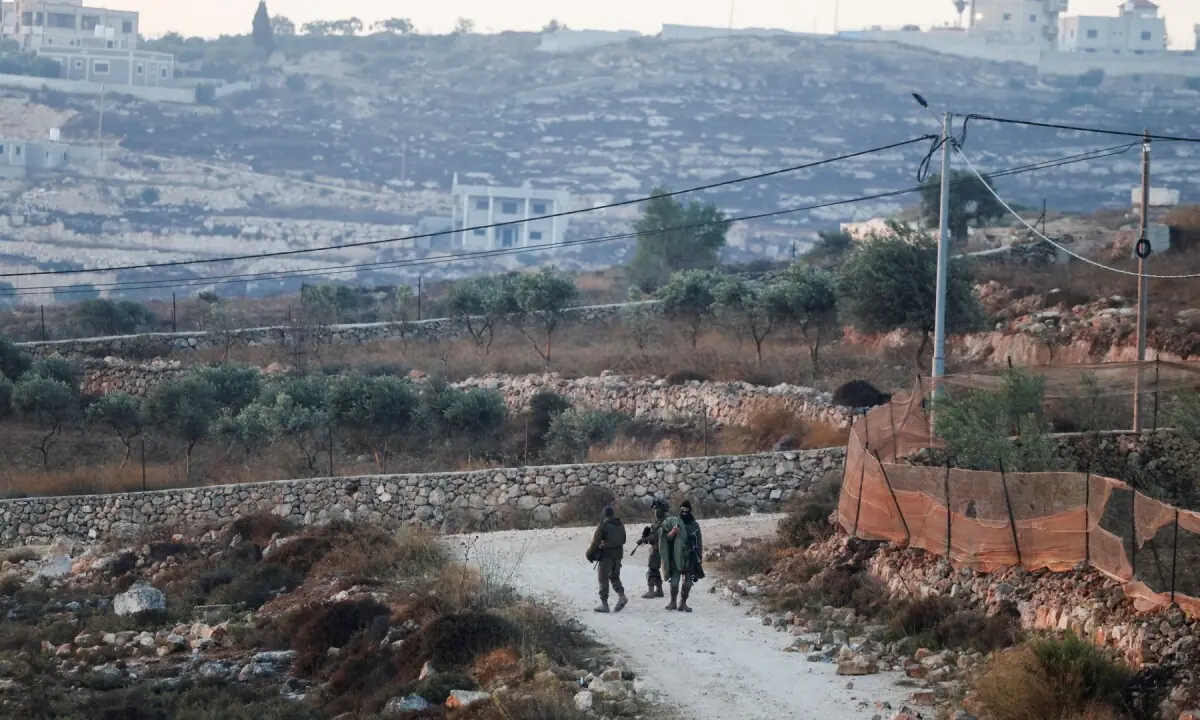
Header image: Israeli soldiers walk near the home of Palestinian-American Loui Ridi. It has been encircled by militant settlers for more than a week, after Ridi gained access to it, in Qusra, Israeli-occupied West Bank on August 18, 2026. —Reuters
Israeli settlers choke West Bank water lifelines
Pakistan warns UN Security Council of ‘tipping point’ in occupied West Bank
Palestine issue is a matter of principle
NewsKit Publishing Platform
Related stories
US public support for Iran war falls as Trump approval at record…
Backing in the United States for the war on Iran has fallen as President Donald Trump's approval remains at a record low, a Reuters/Ipsos…
Displaced Palestinians in Gaza face intensifying Israeli strikes
Attention has turned to displaced Palestinians in Gaza face intensifying Israeli strikes, a development that is being followed closely by readers who track world…
Ambush in South Sudan kills peacekeeping troops
Published On 24 Aug 202624 Aug 2026. An ambush has killed two United Nations peacekeepers in South Sudan.
International Business5 sectors and a warning for world: US launches ‘Op Economic…
Attention has turned to international Business5 sectors and a warning for world: US launches 'Op Economic, a development that is being followed closely by…