
The Mirage Of New Provinces: Weak Institutions And Political Power Rivalries
The Mirage Of New Provinces: Weak Institutions And Political Power Rivalries The more troubling concern is political. The creation of new provinces risks becoming an exercise in elite bargaining rather than public reform Raza Rumi Analysis, Main Slider August 13, 2026 Pakistan’s perennial debate over new provinces has resurfaced with familiar urgency. It is often…
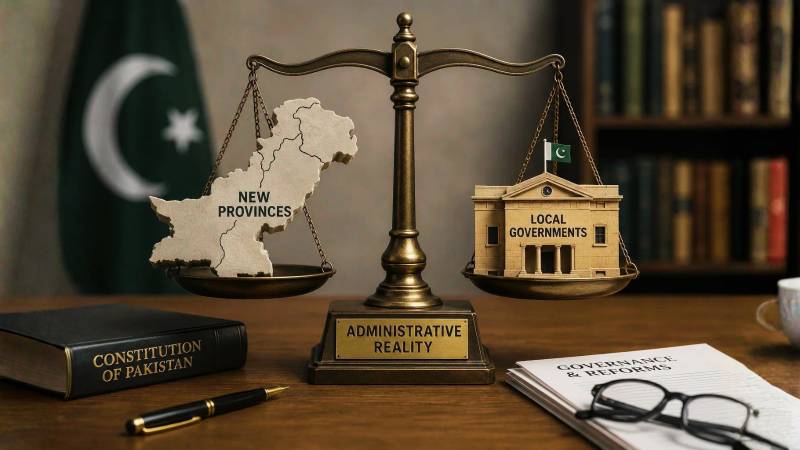
Key points
- In countries such as Nigeria and Ethiopia, the multiplication of sub-national units has not necessarily strengthened democracy or improved governance.
- The constitutional and political complexities of creating new provinces further complicate the picture.
- While proponents of new provinces emphasize administrative efficiency, identity politics remains an undercurrent that is difficult to contain.
- Against this backdrop, the GTTN report offers an alternative that is both less dramatic and more consequential: meaningful local government.
The more troubling concern is political. The creation of new provinces risks becoming an exercise in elite bargaining rather than public reform
- Raza Rumi
- Analysis, Main Slider
- August 13, 2026
Pakistan’s perennial debate over new provinces has resurfaced with familiar urgency. It is often framed as a corrective—an administrative fix to bring governance closer to the people, address regional inequities, and ease the burden on overcentralized provincial capitals. At one level, this instinct is understandable. There is a deep and widening sense of alienation in many parts of the country. Peripheral districts, smaller towns, and historically neglected regions feel locked out of decision-making and deprived of state services.
Yet a recent report by the Global Think Tank Network (GTTN) “The Mirage of New Provinces: Why Pakistan Needs Local Government Reform, Not Territorial Fragmentation” offers a sobering counterpoint. The problem, it argues, is not the map. It is the state. This is not a trivial distinction. The report contends that Pakistan’s governance crisis stems less from the size or number of provinces and more from the absence of effective institutions, political will, and crucially empowered local governments. “The pathology lies not in provincial boundaries,” it notes, “but in the absence of effective governance.” That formulation alone should give pause to a debate that too easily gravitates toward territorial re-engineering.
The temptation to redraw boundaries is not new. Across the world, states have experimented with creating smaller administrative units to improve efficiency or manage diversity. But the evidence is mixed at best. In contexts where institutions are weak and elite capture is entrenched, fragmentation often produces more bureaucracy, more patronage, and more competition over resources without necessarily improving service delivery. Pakistan fits that profile uncomfortably well.
New provinces do not emerge as neat administrative abstractions. They require entire infrastructures: new secretariats, cabinets, assemblies, police commands, and judicial systems. In a country already struggling with fiscal constraints, this expansion would increase non-development expenditure at the expense of investment in education, health, and infrastructure. Pakistan does not suffer from too little bureaucracy; it suffers from unresponsive and inefficient institutions.
While important, is not decisive, but the fiscal argument. The more troubling concern is political. The creation of new provinces risks becoming an exercise in elite bargaining rather than public reform. It opens new avenues for patronage, new offices to be filled, and new networks of influence to be constructed. In such a scenario, the beneficiaries are unlikely to be ordinary citizens seeking better services. They are more likely to be political actors adept at navigating institutional transitions.
Comparative experience offers cautionary lessons. In countries such as Nigeria and Ethiopia, the multiplication of sub-national units has not necessarily strengthened democracy or improved governance. Instead, it has often entrenched local elites and fragmented already fragile systems. Pakistan, with its own history of centralized authority and uneven development, is hardly immune to similar outcomes.
The constitutional and political complexities of creating new provinces further complicate the picture. Such a move requires broad consensus within provincial assemblies and at the federal level. In practice, this is exceedingly difficult. More importantly, any perception that provinces are being reconfigured without genuine consent would raise serious concerns concerning federal balance. Smaller provinces, already sensitive to issues of autonomy, could interpret such moves as encroachments rather than reforms.
The report’s discussion of Senate representation is particularly instructive. Pakistan’s upper house is designed to give equal weight to provinces irrespective of population. The creation of additional provinces would therefore have significant implications for political representation. Ironically, fragmentation could enhance the aggregate influence of already dominant regions while disadvantaging others. What is presented as a corrective could deepen existing asymmetries.
What happened
Equally important is the question of fiscal federalism. Pakistan has struggled to sustain a functional National Finance Commission process even under the current structure. The addition of new provinces would introduce more actors, more competing claims, and greater complexity in revenue sharing. In a system already prone to delay and contention, this could further weaken the state’s capacity to coordinate policy and allocate resources effectively.
In contexts where institutions are weak and elite capture is entrenched, fragmentation often produces more bureaucracy, more patronage, and more competition over resources without necessarily improving service delivery.
The ethnic dimension cannot be ignored either. While proponents of new provinces emphasize administrative efficiency, identity politics remains an undercurrent that is difficult to contain. In Pakistan’s context, territorial reconfiguration has historically intersected with questions of ethnicity and language. The risk is that new provinces may reinforce, rather than dilute, identity-based mobilization—adding another layer of contestation to an already fragmented polity.
Against this backdrop, the GTTN report offers an alternative that is both less dramatic and more consequential: meaningful local government. This is not a novel idea, but it remains persistently under-implemented. Pakistan has experimented with devolution before, most notably during the early 2000s. That experience was uneven, yet it demonstrated a simple truth: governance improves when it is closer to citizens—provided local institutions are given real authority and resources.
The report calls for a constitutionally protected system of local government with fiscal autonomy, clearly defined functions, and professional administration. It emphasizes significant revenue transfers to local bodies, the devolution of key service delivery sectors, and the use of technology to enhance transparency. It also underscores the need for police reforms rooted in local accountability where the disconnect between state and citizen is often most visible.
The details
This is a compelling agenda. It addresses the everyday realities of governance—the quality of schools, the availability of clean water, the maintenance of roads, and the responsiveness of officials. These are the domains where citizens experience the state most directly. Yet there is a limitation that merits reflection. While the report correctly diagnoses the problem and outlines a credible reform agenda, it is less clear on how the entrenched political economy of resistance will be overcome. Provincial elites have historically been reluctant to devolve power downward. When empowered, challenge established hierarchies and redistribute influence, local governments. Without confronting this resistance, even well-designed reforms risk remaining aspirational.
This is where the debate needs to mature. The question is not simply whether new provinces are desirable. It is whether Pakistan is willing to undertake the deeper, more difficult task of institutional reform. Redrawing boundaries is visible and politically attractive. It signals action, even if its effects are uncertain. Strengthening local governance, by contrast, is incremental, complex, and often less visible. It requires sustained commitment and a willingness to cede power. But it is also, almost certainly, more effective.
Citizens are not asking for new maps. They are asking for functioning institutions; schools that teach, hospitals that heal, streets that are maintained, and officials who are accountable. These are not abstract demands. They are the foundations of a working state. The GTTN report’s core argument is therefore both timely and necessary. Without institutional reform, new provinces will merely replicate existing dysfunctions at a smaller scale. Pakistan stands at a familiar crossroads. It can pursue the symbolism of territorial change, or invest in the substance of governance. The former is easier. The latter is harder—but far more consequential. As always, is political, the choice.
Facebook Comments
Related stories

How to Get Rs. 750,000 Subsidy on Green Tractors in Punjab
The Punjab government has opened applications for another phase of the Chief Minister Punjab Green Tractor Program, offering farmers a… Read More The post…
Punjab Introduces New System to Monitor Food Item Prices
The Punjab government has developed a new mechanism to determine and monitor the prices of vegetables, fruits, meat, milk and… Read More The post…

Socialists capture major Florida victory on hit-or-miss night for Trump-endorsed primary candidates
Trump endorsements delivered mixed results across Florida and Wyoming primary elections, as some backed candidates lost key congressional races.
Diesel relief ordered as PM directs minister to head to Karachi
Diesel relief ordered as PM directs minister to head to Karachi