How Darwin Made Hindu Mythology ‘Scientific’
When Charles Darwin published On the Origin of Species in 1859, his theory collided with the dominant Christian reading of the Bible.
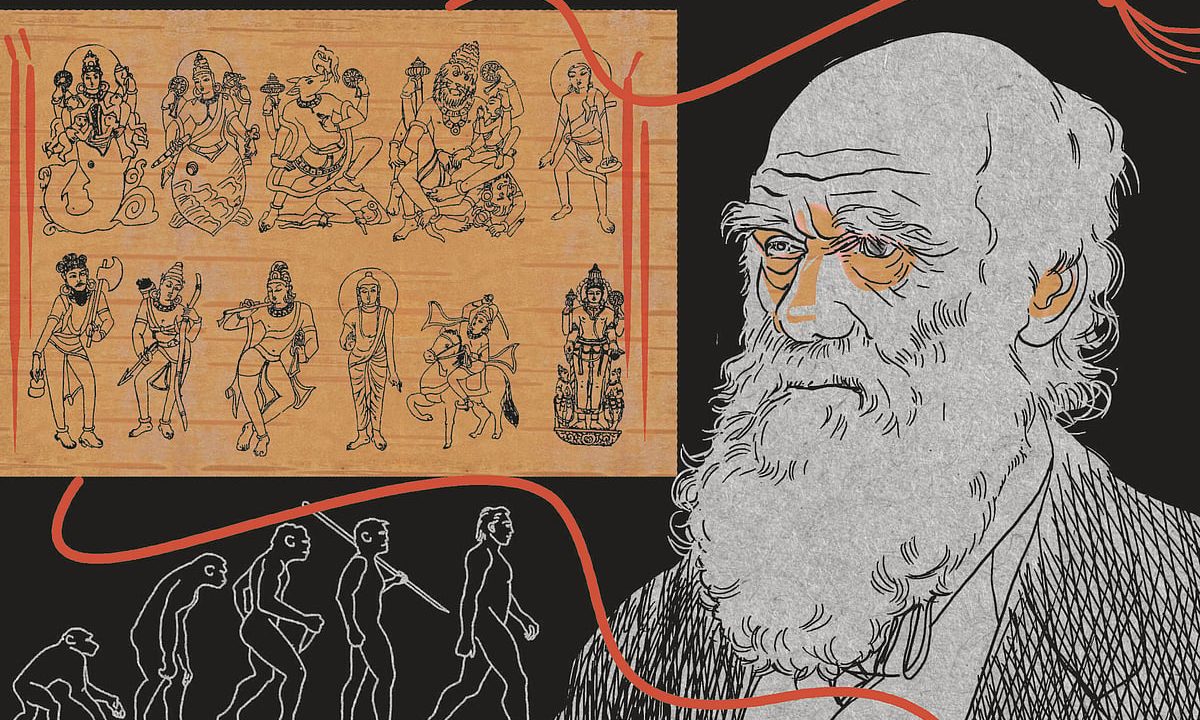
When Charles Darwin published On the Origin of Species in 1859, his theory collided with the dominant Christian reading of the Bible.
Article outline
- What happened
- Background
- Why it matters
- The bottom line
Key points
- Jayadeva's 12th-century Gita Govinda celebrated Matsya, Kurma, Varaha, Narasimha, Vamana, Parashurama, Rama, Balarama, Buddha, and Kalki.
- They asserted that Darwin had rediscovered what Hindu sages had known thousands of years earlier.
- Keshab Chandra Sen of the Brahmo Samaj popularised this "avataric evolutionism".
- But the Dashavatara sequence itself had not existed from Vedic times.
- Since these texts had grown through repeated editing, no exact year could be assigned.
Darwinism, therefore, challenged Biblical chronology, separate creation and human uniqueness. Since numerous Christians eventually read Genesis symbolically, it did not oppose every feasible interpretation of the Bible. But it clearly contradicted the literal interpretation defended by influential churches and missionaries.
Hindu mythology proved more accommodating. It contained no single compulsory creation story, no fixed date for creation, and no universally binding first human couple. The Puranas described repeated creations and destructions throughout enormous periods. Gods became animals, humans passed through animal births, and life assumed innumerable forms. Evolution could, therefore, be accepted without destroying the Hindu mythological universe.
Educated Indians shortly went further. They asserted that Darwin had rediscovered what Hindu sages had known thousands of years earlier. The Dashavatara became their favourite evidence. Vishnu's 10 avatars were converted into a biological timeline: Matsya represented aquatic life; Kurma, movement between water and land; Varaha, land mammals; Narasimha, the animal-human transition; and Vamana, primitive humanity. Parashurama became axe-using man; Rama civilised man; Krishna intellectually developed man; Buddha spiritually awakened man; and Kalki the future human.
But the Dashavatara sequence itself had not existed from Vedic times. Individual forms such as Varaha, Vamana, and the cosmic tortoise had ancient roots, but they had not formed one evolutionary sequence. Early Vaishnava texts supplied different lists containing four, six, 10, 12, 22, 24 or more manifestations.
In practice, the familiar sequence of Matsya, Kurma, Varaha, Narasimha, Vamana, Parashurama, Rama, Krishna, Buddha, and Kalki appeared in medieval Puranic compilations such as the Agni Purana and Garuda Purana. Since these texts had grown through repeated editing, no exact year could be assigned. The tenfold scheme was probably established between the eighth and 10th centuries CE.
Even then, there was no universally "correct" list. Jayadeva's 12th-century Gita Govinda celebrated Matsya, Kurma, Varaha, Narasimha, Vamana, Parashurama, Rama, Balarama, Buddha, and Kalki. Krishna was excluded since he was the supreme deity whose avatars were being praised. While some regional lists inserted Jagannath or Vithoba, south Indian traditions often retained Balarama. In practice, the apparently perfect evolutionary sequence applied today was selected from competing medieval arrangements.
Meanwhile, the Darwinian comparison additionally collapsed scientifically. Half-lion, half-human beings had never formed an evolutionary stage. Dwarfs had not preceded full-sized humans. Axes belonged to technological history, not biological evolution. Rama, Krishna, and Buddha represented religious ideals, not new species. The argument shifted silently from zoology to technology, kingship, morality, and spirituality.
Nevertheless, it served a powerful colonial purpose. European missionaries had presented Christianity as truth and Hindu mythology as superstition. Darwin now embarrassed Biblical literalism. Indian intellectuals seized the opportunity. While Hinduism appeared open to vast time, changing forms and animal-human continuity, christianity appeared trapped by Genesis. Myths formerly mocked as fantastic could now be advertised as coded scientific knowledge.
Keshab Chandra Sen of the Brahmo Samaj popularised this "avataric evolutionism". In 1882, he described the avatar as rising through fish, tortoise, and boar towards humanity and divinity. Evolution became a spiritual journey: matter developed into vegetation, animal life, humanity, and finally divine consciousness.
Meanwhile, the Theosophical Society carried this argument further. Helena Blavatsky treated Hindu myths as coded accounts of cosmic evolution. Theosophy borrowed scientific vocabulary while promoting untestable ideas regarding spiritual evolution, lost continents, and "root races".
Sri Aurobindo produced a subtler interpretation. He did not simply claim that the Puranas had discovered Darwinism. He treated the Dashavatara as a parable of evolution. Matter concealed life, life concealed mind, and mind concealed higher consciousness. For context, the avatar represented divine power descending to assist this upward movement. By that logic peace-loving Buddha was seen as more evolved than war-mongering Krishna who was more evolved than the passive Ram who was more evolved than the aggressive Parashuram. Such readings ignored alternate interpretations that the avatar ideas was applied by Brahmins to accommodate folk deities and hero cults.
Darwin did not demonstrate that Hindu mythology was scientific. Hindu mythology merely offered less resistance to evolution than literal Biblical creationism. Its multiple creations, vast time cycles, and fluid boundaries between animals, humans, and gods created Darwin easier to absorb. Colonial Indians then converted this compatibility into a claim of priority: Europe had discovered evolution scientifically, but India had supposedly known it mythologically. For context, the claim is still popular in WhatsApp groups seeking to restore pride in ancient Indian achievements. This reveals modern cultural anxiety more clearly than ancient scientific knowledge.
Posts on X: @devduttmyth.
In short, how Darwin Made Hindu Mythology 'Scientific' is the central thread here, and readers can expect follow-up reporting as the picture becomes clearer.