LUMS Launches CAPE To Investigate Sources of Air Pollution in Punjab
In practice, the Lahore University of Management Sciences (LUMS) has introduced the Centre for Air Pollution and Environment (CAPE), a new centre dedicated to identifying the sources of air pollution in Punjab.
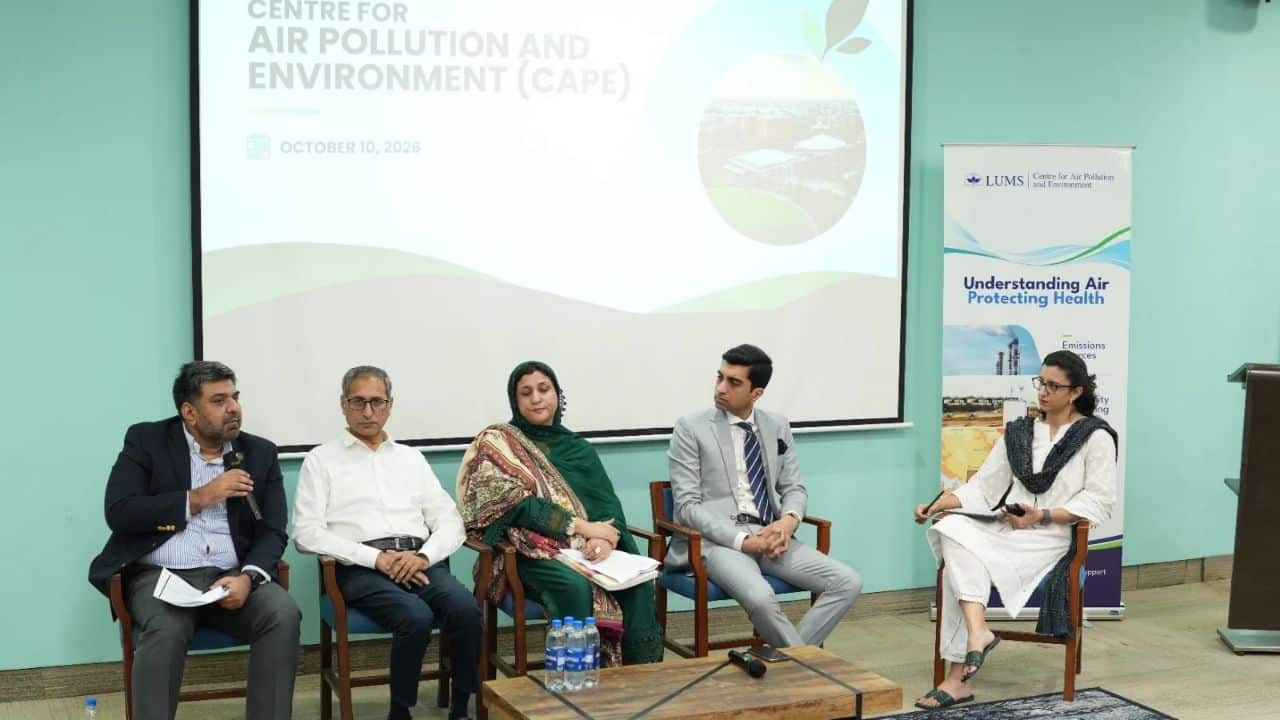
In practice, the Lahore University of Management Sciences (LUMS) has introduced the Centre for Air Pollution and Environment (CAPE), a new centre dedicated to identifying the sources of air pollution in Punjab.
Article outline
- What happened
- What comes next
- Official response
- The key numbers
- The bottom line
Key points
- Qasim Imtiaz, a faculty member in the Department of Chemistry and Chemical Engineering at LUMS, is leading the centre as its founding director.
- Osman Khalid Waheed, Member Board of Trustees of LUMS, presented shields to the speakers at the conclusion of the event.
- Tariq Mahmood Jadoon, Provost, LUMS, delivered the opening remarks, highlighting why LUMS is establishing CAPE and the need for stronger scientific evidence to address air pollution.
- Shahid Hussain, Rector, LUMS, concluded the proceedings with a note of thanks to the speakers, participants, and partners for their contributions to the launch.
- Qasim Imtiaz remarked, To address air pollution effectively, we need systematic measurements that tell us which sources contribute to particulate pollution and by how much.
Dr. Qasim Imtiaz, a faculty member in the Department of Chemistry and Chemical Engineering at LUMS, is leading the centre as its founding director. Dr. Farah Remarked, Dr. Shahana Khurshid, and Dr. Walther Schwarzacher are members of the CAPE team.
In practice, the launch brought together LUMS leadership, members of CAPE's Policy Advisory Board, provincial administration departments, air-quality organizations, researchers, and development partners to discuss Punjab's air-pollution challenges and the evidence required to address them.
Speaking at the launch, Dr. Tariq Mahmood Jadoon, Provost, LUMS, delivered the opening remarks, highlighting why LUMS is establishing CAPE and the need for stronger scientific evidence to address air pollution. Dr. Walther Schwarzacher, Dean of the Syed Babar Ali School of Science and Engineering additionally spoke concerning the centre's establishment within the school.
Presenting the centre's mission and work packages, Dr. Qasim Imtiaz remarked, "To address air pollution effectively, we need systematic measurements that tell us which sources contribute to particulate pollution and by how much. CAPE will build this evidence and work with administration, researchers, and communities to translate it into targeted interventions that protect public health."
In practice, the centre's work will focus on understanding pollution sources and their impacts, assessing indoor air quality in schools, and strengthening links between scientific evidence, communities, and policy. Its source-apportionment study will analyze the chemical composition of particulate matter collected throughout Punjab to determine the contribution of different pollution sources.
In a session moderated by Dr. Shahana Khurshid, representatives of the Environment Protection and Climate Change Department, Urban Unit, and Pakistan Air Quality Initiative presented their ongoing work on Punjab's smog mitigation framework, air-quality monitoring, sectoral emissions inventories, air-quality action intends, and citizen monitoring and advocacy. As well as areas where further scientific evidence is needed to understand the province's air pollution burden and to inform effective interventions, the presentations and discussions examined existing data and monitoring efforts in Punjab.
Notably, the launch additionally featured a panel discussion moderated by Dr. Farah Remarked, with Muhammad Hassaan Ahsan, Secretary, Provincial Transport Authority, Transport and Mass Transit Department, Administration of the Punjab; Muhammad Ahsan Younas, Managing Director, Punjab Safe Cities Authority; Zahida Azhar, Extra Secretary (Universities), Higher Education Department, Administration of the Punjab; and Dr. Muhammad Zaman, Professor, School of Sociology, Quaid-I-Azam University.
Meanwhile, the panel examined the air-quality challenges facing Punjab and the research priorities stakeholders would like CAPE to pursue, including areas where evidence could support assess pollution-control measures. The discussion additionally highlighted Punjab's efforts to strengthen vehicle-emissions testing and apply Safe City systems to monitor environmental violations. The speakers additionally underscored the need for reliable data and further scientific research to assess pollution sources, evaluate the impact of control measures, and guide evidence-based policy decisions. The discussion reinforced the role of collaboration between administration departments, researchers, and other stakeholders in addressing air pollution.
Air pollution remains a major environmental health challenge in Pakistan. Recent estimates indicate that reducing ambient air pollution to international health guidelines could growth average life expectancy by concerning 2.6 years in Karachi, 4.6 years in Islamabad, and 5.3 years in Lahore. These figures underscore the severity of current exposure levels and the potential public-health benefits of effective air-quality management. Stay Connected with ProPakistani. Obtain the latest news and stories wherever you prefer. Follow on Google Discover. Follow on Google News Join WhatsApp. See more ProPakistani stories in Google Search and Top Stories.
In short, LUMS Launches CAPE To Investigate Sources of Air Pollution in Punjab is the central thread here, and readers can expect follow-up reporting as the picture becomes clearer.