Our children must be patient listeners, ask difficult questions even when posing truth to power: Ex-CJI
Our children must be patient listeners, ask tough questions even when posing truth to power: Ex-CJI Speaking at the plenary session of the 10th Annual IC3 Conference, Justice Chandrachud highlights the importance of access to education for all.
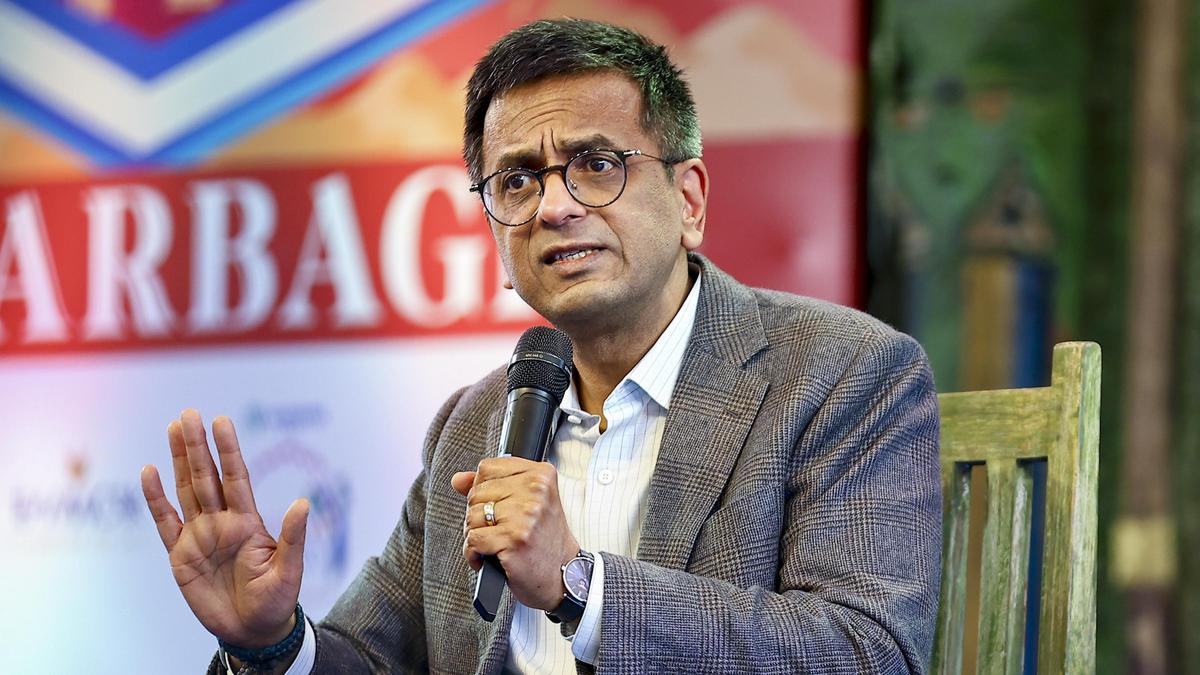
Our children must be patient listeners, ask tough questions even when posing truth to power: Ex-CJI Speaking at the plenary session of the 10th Annual IC3 Conference, Justice Chandrachud highlights the importance of access to education for all.
Article outline
- What happened
- Why it matters
- The key numbers
- The bottom line
Key points
- Chandrachud on Wednesday (August 19, 2026) remarked the youth must possess the ability to ask challenging questions "even when they pose truth to power".
- The theme of this year's conference organised by the IC3 Movement is 'Looking Deeply – From Information to Insight'.
- Saying that literacy and higher education were linked to greater autonomy and empowerment throughout the world, Justice Chandrachud went on, Access is only the beginning.
- According to Justice Chandrachud, passing traditional knowledge from one generation to another, like in Japan, helps a country develop a national memory.
- Justice Chandrachud remarked the country needed an inclusive educational system where all children who learn differently are accommodated and celebrated.
Former Chief Justice of India D.Y. Chandrachud on Wednesday (August 19, 2026) remarked the youth must possess the ability to ask challenging questions "even when they pose truth to power". He was speaking at the plenary session of the 10th Annual IC3 Conference.
"In an age of technology, our children must become patient listeners, willing observers and possess the ability to ask difficult questions even when they pose truth to power." Referring to challenges posed by artificial intelligence (AI), he remarked, "Once, the difficulty was finding information. Now, the difficulty is to understand what deserves to be knowledge, " he remarked.
Notably, the theme of this year's conference organised by the IC3 Movement is 'Looking Deeply – From Information to Insight'. The two-day conference, held in Mumbai on August 19 and 20, brought together school counsellors, university representatives, industry leaders, diplomats and policymakers from more than 60 countries, including the United States, the United Kingdom, Australia, Japan and Spain, alongside hundreds of students, parents and teachers.
Saying that literacy and higher education were linked to greater autonomy and empowerment throughout the world, Justice Chandrachud went on, "Access is only the beginning. Our young still need guidance to distinguish evidence from assertion, significance from novelty, understanding from familiarity and judgement from opinion."
He highlighted the challenges of unequal opportunities in education and the lack of adequate investment. Lauding students for their ability to navigate technology, he asked why our educational system was keen to mainstream everyone without recognising the needs and capabilities of individuals. Raising the matter of accessibility to school for rural girls after hitting puberty, the former CJI stated there was a need to widen access to knowledge.
"We speak of expanding access to education, but can we really be satisfied with a classroom and a mid-day meal where, in 2025-26, 1, 05, 000 schools still lacked proper toilet facilities for girls, including thousands where no girls' toilets existed at all? The reality is, so plenty of menstruating young girls drop out of schools as there is no toilet for them to employ, " he remarked.
Justice Chandrachud remarked the country needed an inclusive educational system where all children who learn differently are accommodated and celebrated. "All of them belong to the future we define as our demographic dividend. We need an inclusive India. It is time to redefine merit and to bring the last student into the mainstream. Education should leave room for curiosity, " he remarked.
According to Justice Chandrachud, passing traditional knowledge from one generation to another, like in Japan, helps a country develop a national memory. "We have become extraordinarily good at gathering information around us. We should celebrate that progress. But modern knowledge shouldn't create us forget what earlier generations had learnt, " he stated.
In short, our children must be patient listeners, ask difficult questions even when posing is the central thread here, and readers can expect follow-up reporting as the picture becomes clearer.