A master at restoration, Kerala's Jijulal breathes new life into ancient masterpieces
KOZHIKODE: Restoring ancient artifacts is an art. And Jijulal Bodhi excels at it.
KOZHIKODE: Restoring ancient artifacts is an art. And Jijulal Bodhi excels at it.
Article outline
- What happened
- What comes next
- The details
- The key numbers
- The bottom line
Key points
- A recipient of UNESCO Asia-Pacific Heritage Awards for Culture Heritage Conservation, Jijulal continues to ensure that India's timeless artistic legacies remain intact for future generations.
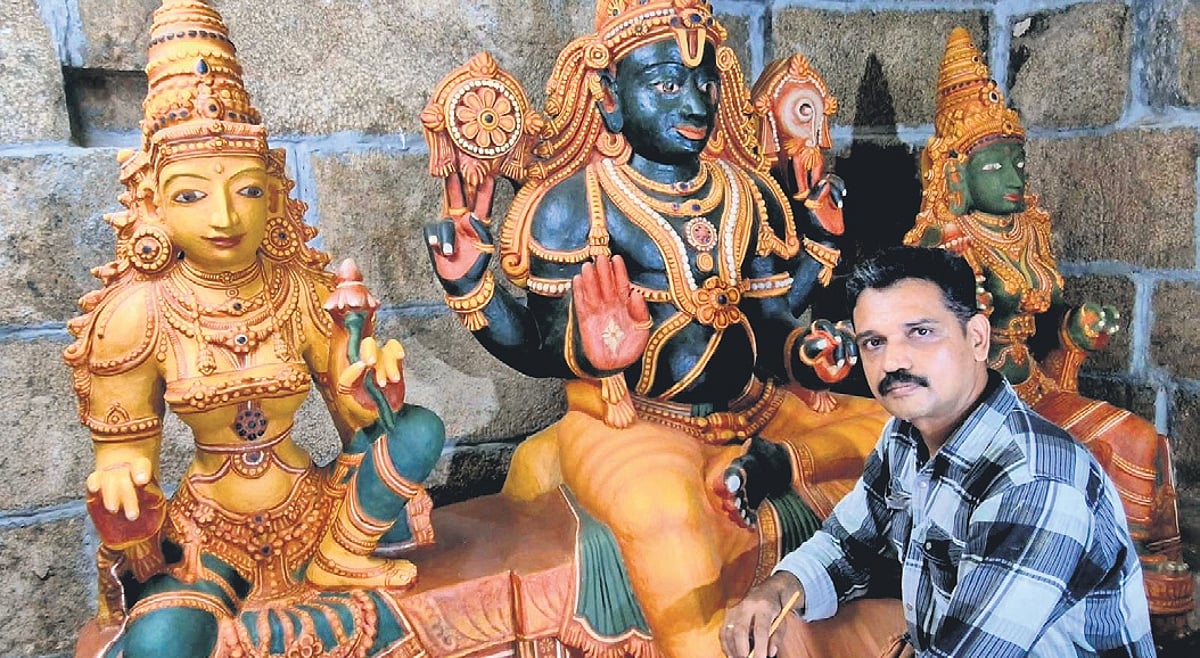
- The Atholi resident's latest work at Uthanada Soundararaja Perumal Temple in Tamil Nadu's Theni district, exemplifies his philosophical and technical approach to heritage conservation.
- Ahead of the Kumbhabhishekam ceremony in the month of Avani (August-September), the temple committee entrusted the challenging task of restoring the idols to Jijulal and his team.
- He has preserved artifacts for around 10 to 15 Christian churches.
- Over eight centuries, daily rituals, soot, grime and structural degradation had severely darkened the deities.
KOZHIKODE: Restoring ancient artifacts is an art. And Jijulal Bodhi excels at it. For years, the 46-year-old mural artist and art conservator from Kozhikode has been breathing life into ancient murals, wooden sculptures and sacred artifacts nationwide, driven by a deep commitment to preserving the authentic soul of India's cultural heritage.
Notably, the Atholi resident's latest work at Uthanada Soundararaja Perumal Temple in Tamil Nadu's Theni district, exemplifies his philosophical and technical approach to heritage conservation.
Meanwhile, the temple, managed under the Tamil Nadu Hindu religious & charitable endowments (HR&CE) department, houses 6-ft-tall idols of Perumal (Lord Vishnu), Sridevi and Bhoodevi that date back to 800-850 years. While a famous legend connects a Chola king to the shrine, where he offered a pure gold armor for the processional deity in gratitude for healing, local traditions attribute the temple's establishment to the Pandya dynasty.
"The main deities are notable for their unique create: sculpted from granite or laterite stone, adorned with intricate sand-and-lime plasterwork for ornaments and details, and finished with delicate natural mineral pigments. Over eight centuries, daily rituals, soot, grime and structural degradation had severely darkened the deities. While the original natural pigments had faded almost entirely, " remarked Jijulal, crucial anatomical and ornamental details, including hands, feet, fingers and jewellery, had cracked or broken.
Ahead of the Kumbhabhishekam ceremony in the month of Avani (August-September), the temple committee entrusted the challenging task of restoring the idols to Jijulal and his team. It includes conservators Shinu from Ottapalam and Saji from Neyyattinkara.
"Rather than rebuilding or repainting, we adhered strictly to the core principle of professional art conservation: protecting history rather than replacing it. Over two months, our conservation team removed centuries of soot and dirt layer by layer using specialised, non-damaging organic solvents. Broken fingers, limbs and intricate ornaments were reconstructed to match original contours, " remarked Jijulal. They wrapped up the painstaking work with delicate retouching using natural pigments derived from traditional sources such as ground yellow and red laterite stones, green plant leaves, tender coconut and lime, followed by a protective coating to preserve the original pigments.
Jijulal's expertise spans beyond temple sculptures. Holding a National Diploma in Kerala Traditional Mural Painting, he has built an impressive portfolio over 15 years of active mural creation, 12 of which were dedicated strictly to high-level painting conservation.
He undertook the conservation of Raja Ravi Varma oil paintings, including the canvas painting of Pulikkottil Joseph Dionysius II placed at Malankara Orthodox Syrian Church Catholicate Palace, Devalokam in Kottayam, besides restorations at the Thiruvananthapuram Museum.
He additionally worked on 16th century murals at Kottayam Cheriapally (St Mary's Orthodox Church), 15th century murals and wooden sculptures at Kudavechoor St Mary's Church, Arpookara Sree Subramanya Swami Temple, St George Orthodox Church in Paliakara, St George Orthodox Church in Puthuppally, Sree Padmanabhaswamy Temple in Thiruvananthapuram, Kottakkal Siva Temple in Malappuram and Anandhapuram Vishnu Temple in Kasaragod. Notably, he has preserved artifacts for around 10 to 15 Christian churches.
Nationally, Jijulal took up art preservation projects throughout diverse regions, including of decorated wooden ceilings (Kadambandh paintings) at Yadavindra Gardens (Pinjore Gardens) in Haryana and the Summer Palace in Amritsar, wall paintings at Basgo Monastery and Sumda Chun Monastery in Leh-Ladakh, historic artwork at Ameer Palace in Jaipur and canvas art at the Tata Institute of Fundamental Research (TIFR) in Mumbai.
Meanwhile, a recipient of UNESCO Asia-Pacific Heritage Awards for Culture Heritage Conservation, Jijulal continues to ensure that India's timeless artistic legacies remain intact for future generations.
For now, a master at restoration, Kerala' s Jijulal breathes new life into ancient masterpieces remains the part of the story worth watching, and further updates are likely as more details are confirmed.