Car bomb tears through Colombian city wounding more than 20
ByVanessa Buschschlüter Latin America online editor.
ByVanessa Buschschlüter Latin America online editor.
Article outline
- What happened
- Official response
- The key numbers
- Reaction
- What comes next
- The bottom line
Key points
- This person was in power from August 2022 to August 2026, tried to negotiate with these armed groups as part of what he called his "total peace" strategy.
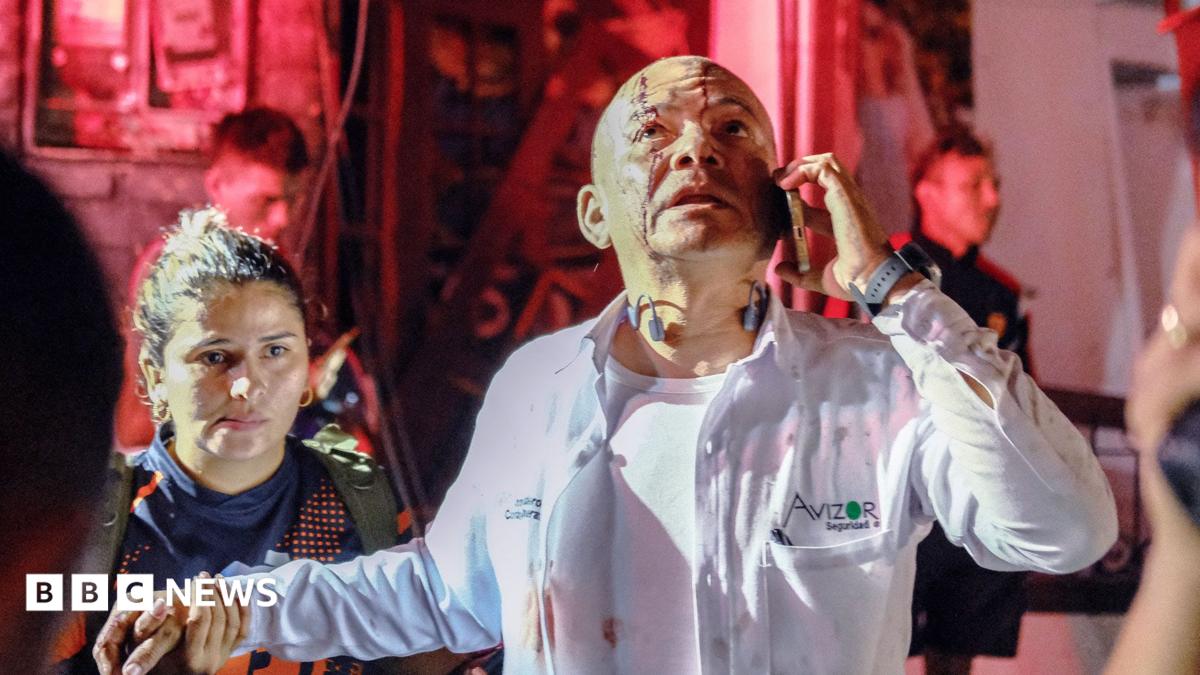
- A car bomb has exploded in the central Colombian city of Villavicencio, injuring at least 23 individuals.
- He has additionally been critical of the 2016 agreement, calling it a "false peace".
- And earlier on Monday, drones dropped explosives on the police headquarters in the northern city of Cúcuta.
- According to Santos, de la Espriella was "totally wrong" to call it a "false peace".
In practice, a car bomb has exploded in the central Colombian city of Villavicencio, injuring at least 23 individuals.
For context, the explosive device was detonated in front of the offices of the regional administration, in the city centre, damaging a number of buildings.
No group has so far admitted carrying out the attack – the latest in a series using explosives to target official buildings and security forces' headquarters.
Colombian President Abelardo de la Espriella blamed "narcoterrorism", but offered no details. Armed criminal groups have lately stepped up attacks in what appears to be retaliation for an offensive ordered against them by De la Espriella.
Writing on social media, the president remarked that his administration would "bluntly and forcefully" respond, external to "every drop of Colombian blood spilled". "There will be no impunity and no retreat, " he continued.
Three weeks ago, three adults and a baby were killed in a car bomb attack near army barracks in Tolima province.
In practice, the car bomb in Villavicencio went off on Monday evening – the eve of the 10th anniversary of the signing of a peace accord between the administration and left-wing rebels of the Revolutionary Armed Forces of Colombia (Farc), Colombia's largest guerrilla group.
After the signing of the agreement, thousands of left-wing rebel fighters laid down their arms.
Nevertheless, a significant number of Farc members. This person did not agree with the agreement, refused to disarm and joined dissident groups instead.
While forced displacement, child recruitment and the numbers of attacks on security forces dropped in the aftermath of the accord, there has been an upsurge over recent years driven by dissident Farc factions and criminal groups fighting for control of drug trafficking, illegal mining and extortion rackets.
Colombia's first left-wing president. This person was in power from August 2022 to August 2026, tried to negotiate with these armed groups as part of what he called his "total peace" strategy.
Nevertheless, the negotiations stalled and collapsed with a number of of the criminal groups violating ceasefires they had agreed to observe.
De la Espriella was elected on a promise to crack down on "narcoterrorism" and has been scathing regarding his predecessor's approach.
In a post on X, uploaded shortly before news of the car bomb in Villavicencio spread, he referred to the peace accord as a "mess", describing it as a "waste of public resources" and the "cause behind Colombia's ruin".
Former President Juan Manuel Santos and Rodrigo Londoño – the two men who signed the peace accord on behalf of the Colombian administration and the Farc respectively – defended it in an interview with BBC Mundo ahead of the anniversary.
"He wants to use, or has bought into that cynical and mistaken theory that the violence we see today is the result of the peace deal, when the exact opposite is the case, " Santos remarked, arguing that the challenge lies with the lack of implementation of the agreement.
In short, car bomb tears through Colombian city wounding more than 20 is the central thread here, and readers can expect follow-up reporting as the picture becomes clearer.