Kerala marine scientist conquers North Pole, records global warming impact
At was around 3 pm on August 8. Icebreaker vessel 50 Let Pobedy reached 89.6616 degree North latitude in the Arctic Ocean.
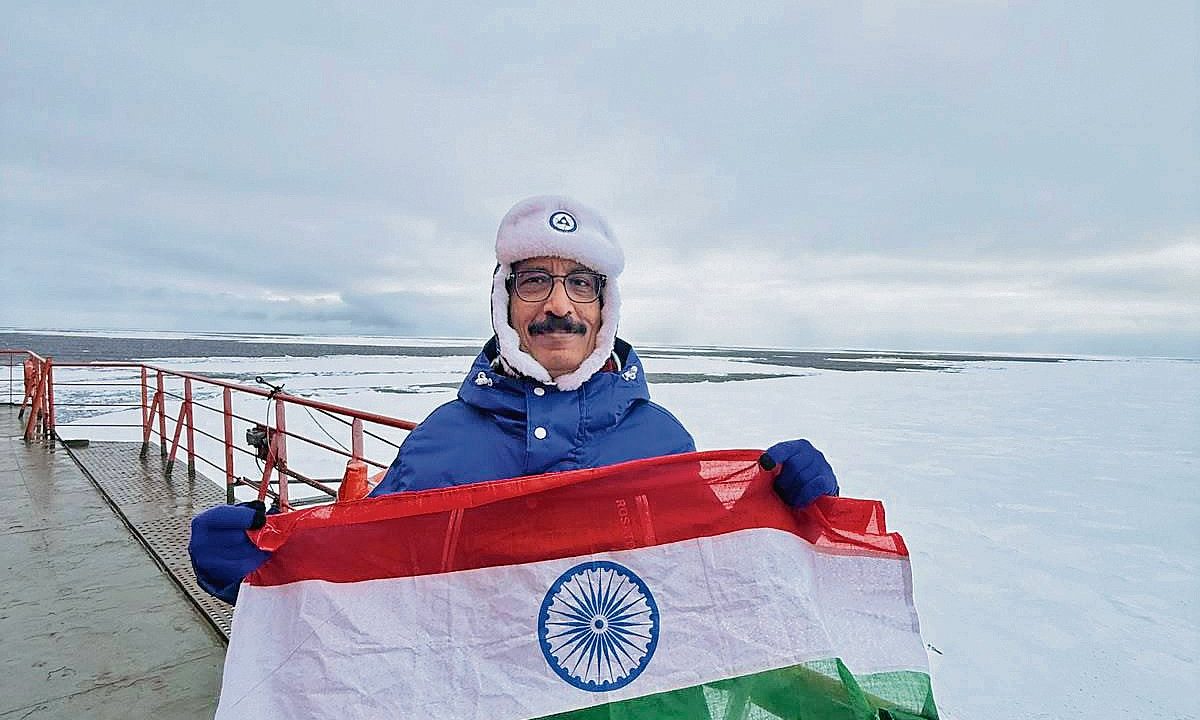
At was around 3 pm on August 8. Icebreaker vessel 50 Let Pobedy reached 89.6616 degree North latitude in the Arctic Ocean.
Article outline
- What happened
- The key numbers
- Why it matters
- The bottom line
Key points
- From Murmansk, the expedition team boarded 50 Let Pobedy (meaning "50 Years of Victory"), a massive Arktika-class nuclear-powered icebreaker operated by Rosatom.
- Lucky Rawat, a 15-year-old student from Chakrata in Uttarakhand, additionally accompanied him as India's sole student representative.
- He was part of the 'Icebreaker of Knowledge', an international educational and scientific expedition to the North Pole organised by Rosatom, the Russian atomic energy corporation.
- The expedition was a global mentoring programme in which 66 highly talented students from throughout the world participated alongside international experts to reach the North Pole.
- Students in the age group of 14-16 were selected through a five-level talent hunt.
"It was an incredible moment. We were standing on the frozen ocean. It was 4, 000 m deep. There was a blizzard, with wind speeds crossing 10 m per second, and my face froze the moment I removed my mask to click a picture, " he recalls.
Bijoy Nandan, dean and scientist emeritus at the Department of Marine Sciences of the Cochin University of Science and Technology (CUSAT), is the first Malayali to step on the North Pole. He was part of the 'Icebreaker of Knowledge', an international educational and scientific expedition to the North Pole organised by Rosatom, the Russian atomic energy corporation.
Notably, the expedition was a global mentoring programme in which 66 highly talented students from throughout the world participated alongside international experts to reach the North Pole. There were experts from diverse fields such as marine science, nuclear engineering, artificial intelligence, radiology and biotechnology. Among them was Sergei Lukyanenko, one of Russia's most popular contemporary science fiction and fantasy authors. Others included Jairo Bastos, a Brazilian researcher-engineer, and Noel Rajabu Mabele, a Tanzanian medical doctor.
Students in the age group of 14-16 were selected through a five-level talent hunt. Globally, 5, 000 students applied for the programme, of whom 22 were selected. Russia selected 44 students from 73, 000 applications. Lucky Rawat, a Class X student from Uttarakhand, was the student representative from India. Meanwhile, the team reached Murmansk, the largest city north of the Arctic Circle in northwestern Russia, on August 3. Murmansk is additionally a prime destination for viewing the Aurora Borealis (Northern Lights). It is visible between September and April.
From Murmansk, the expedition team boarded 50 Let Pobedy (meaning "50 Years of Victory"), a massive Arktika-class nuclear-powered icebreaker operated by Rosatom. The vessel, built in 2007, is one of the world's largest and most powerful ships and is capable of breaking through ice up to 3 m thick. It is 159.6 m long and 30 m wide. A floating giant, the vessel has restaurants, a play area, lecture halls, a gymnasium, swimming pools and sizeable rooms.
"The 2, 500-km voyage through the Arctic Ocean was an amazing experience. We could spot the depleting ice sheets, broken icebergs and barren hills. According to Russian scientists, the depletion of snow cover has been evident over the past two decades. There were only pancake ice formations in place of thick ice sheets. On the third day, we spotted a polar bear. It is additionally under threat due to the changing environment, " he states. The team reached 89.6616 degree North at around 3 pm, disembarked from the ship and walked around 250 m through snowdrifts to reach the northernmost point on Earth.
"We were standing on a frozen ocean that was 4, 000 m deep. There was a blizzard, but we were excited. The students began celebrating and we conducted a flag march to mark the moment. The ship's captain, Ruslan Sasov, additionally joined the celebration. In the polar region, it is six months of day and six months of night. When the Northern Lights will become visible, " notes the marine scientist, the transition to the polar night begins around September. The return journey began late at night, and the team reached Franz Josef Land, a high-latitude Russian Arctic archipelago comprising 192 ice-covered islands. It is located regarding 900 km from the North Pole and is a natural reserve for polar bears and seabirds.
For context, the expedition provided insights into the impacts of global warming on the Arctic. The Arctic Ocean plays a significant role in the global climate system and in the Global Conveyor Belt, a massive, continuous system of deep and surface ocean currents driven by differences in water temperature and salinity. This circulation moves heat, nutrients and carbon around the Earth in a slow cycle that takes regarding 1, 000 years to complete.
"Evidence of Arctic amplification and its impact on global ocean changes is mounting. For example, the presence of aerosols is increasing in the Arctic region. Mercury has additionally been detected in organisms in Svalbard. The impact of Arctic amplification on climate change will be reflected in coastal zones throughout the world, including India, " the eminent oceanographer stated. Notably, the marine scientist recorded the impact of global warming on the Arctic marine ecosystem and how the Arctic Ocean has changed over the decades. "I collected water samples for research purposes. Reaching the North Pole was a gratifying experience and offered me an opportunity to learn concerning the impact of global warming on the region. The team additionally rolled out a balloon equipped with sensors to study changes in the stratosphere, " he noted.
In short, kerala marine scientist conquers North Pole, records global warming impact is the central thread here, and readers can expect follow-up reporting as the picture becomes clearer.