
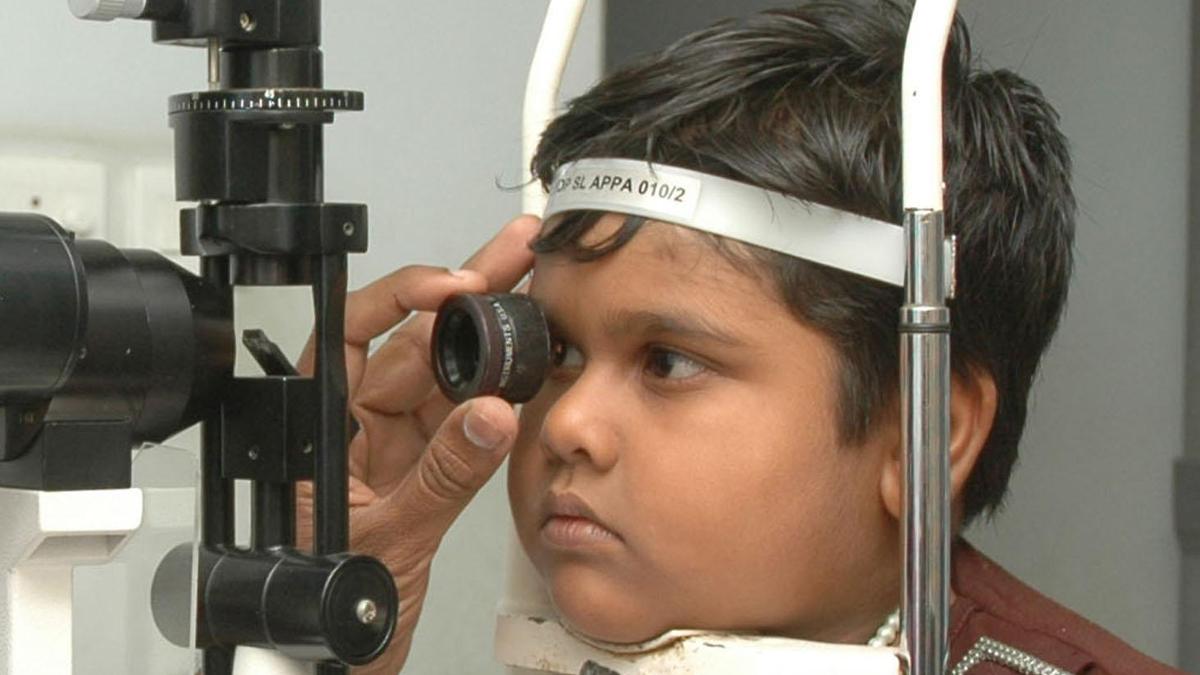
Amblyopia, commonly called lazy eye, occurs when the brain does not adequately process visual input from one eye. The visual pathway may appear anatomically normal, but the input reaching the brain is poorly coordinated or insufficient for normal visual development.
The condition can develop because of an uncorrected refractive error such as farsightedness, nearsightedness or astigmatism. As in squint, can affect binocular vision, misalignment of the eyes. Congenital cataract, corneal opacity and other conditions that obstruct visual input can also cause stimulus-deprivation amblyopia.
Amblyopia is estimated to affect concerning 2% to 4% of children below five years. The actual burden could be higher because numerous children have no obvious symptoms.
“There’s no red eye, no visible squint in most cases, no clinical sign that we can make out,” says Aparna Bhatnagar, senior consultant, ophthalmology, Apollo Speciality Hospitals, Vanagaram, Chennai. A child may simply learn to rely on the eye with better vision and continue with everyday activities without complaint.
This makes screening particularly important. According to Dr. Bhatnagar, routine childhood vision screening is not universal in India, and children can remain undetected despite apparently normal schooling.
Kalpana R, senior consultant, Ophthalmology, SIMS Hospital, Chennai, says school screening programmes can assist identify children, particularly around four to five years of age, and allow treatment to begin early.
The gap is particularly significant among preschool children and those living in rural or semi-urban areas where access to an ophthalmologist may be limited. Also, families dependent on daily wages may find it challenging to lose a day’s work for hospital visits. Even where preschool screening is available through Anganwadi centres, completing the referral to an ophthalmologist can be a challenge.
Early treatment
The timing of treatment matters because visual development takes place during childhood. Correcting a refractive error early can allow vision to develop to its full potential, whereas treatment becomes more difficult and visual outcomes may be more limited when amblyopia is identified afterwards.
Treatment begins by addressing the underlying cause. Refractive errors are corrected with appropriate glasses. If there is a cataract, corneal opacity or another media opacity, surgical treatment may be required, followed by refractive correction where necessary. If the eyes are misaligned, the squint also needs appropriate treatment.
For many children, treatment then involves occlusion therapy, in which the eye with better vision is covered for a prescribed period. This encourages the brain to use the eye affected by amblyopia.
“The normal eye is occluded. So, this lazy eye is forced to see and the brain is forced to function to its fullest capacity,” Dr. Kalpana explains. When treatment begins during the appropriate period of visual development, children can potentially achieve their full visual acuity.
Patching, however, is not always straightforward for children to accept. Some may find an eye patch uncomfortable or feel self-conscious about wearing one at school.
In selected cases, pharmacological penalisation using atropine may be considered. The better-seeing eye is temporarily kept dilated, reducing its ability to accommodate and encouraging the eye affected by amblyopia to function.
Practical modifications can also assist. Dr. Kalpana suggests using frosted spectacle lenses, with the better-seeing eye occluded and appropriate refractive correction provided for the affected eye. This may make treatment less conspicuous and easier to incorporate into school and home routines.
The timing of patching also matters. Children should ideally be engaged in active visual activities while undergoing occlusion. Reading, schoolwork, games and other visually demanding activities provide stimulation to the visual pathway.
Treatment is not usually a matter of a few weeks and can continue for months or even years, depending on the child’s condition and response.
Adherence remains difficult
Adherence is one of the biggest challenges in amblyopia treatment. While children may have to manage discomfort, blurred vision and self-consciousness alongside school, homework and play, parents have to ensure that treatment is followed every day.
Dr. Bhatnagar says electronic monitoring studies have highlighted the gap between treatment prescribed and treatment actually received. In one such study, only about 45% of families achieved the adherence target set by the treating doctor. With appropriate preparation and continuing engagement, adherence roughly doubled.
“This tells me adherence to patching isn’t a parenting failure. It’s a predictable response to an unsustainable task,” she says. Treatment, therefore, needs to consider the practical realities of each family, including parents’ working hours, school timings, the child’s temperament and family routines.
Personal counselling, realistic treatment goals and regular follow-up with the treating ophthalmologist may be useful.
Newer options
Newer approaches are also being explored. Dichoptic or binocular vision therapies use digital platforms to train both eyes together, with the aim of improving stereopsis and binocular visual function. These may include interactive games, augmented-reality systems and gaze-tracking technologies.
Although cost remains a limitation, digital therapies can be useful in children aged four to five years and above. Doctors also point to early comparative data suggesting that some binocular approaches may achieve higher adherence than conventional patching. In one study comparing a gaze-tracking binocular device with patching, median adherence was about 94% with the binocular treatment compared with concerning 84% with patching.
These approaches are not necessarily a replacement for conventional treatment in every child. Rather, they highlight an important principle: the most effective treatment is one that a child and family can realistically complete.
Related stories
US murderer Christa Pike unconscious and on ventilator after failed execution, lawyers…
ByIone Wells, Reporting fromNorth America correspondent in Nashville and Sareen Habeshian.
Djokovic says season has been ‘a big, big struggle’ after latest medical…
Attention has turned to djokovic says season has been a big, big struggle after latest medical, a development that is being followed closely by…
Vance’s fraud crackdown may raise costs for US health insurers, enrollees
Attention has turned to vances fraud crackdown may raise costs for US health insurers, enrollees, a development that is being followed closely by readers…

Over 150 Machines Are Unusable at One of the Biggest Punjab Govt…
More than 150 medical devices at Nishtar Hospital in Multan have been declared unusable, including X-ray, ultrasound and ECG machines, raising reservations concerning difficulties…