
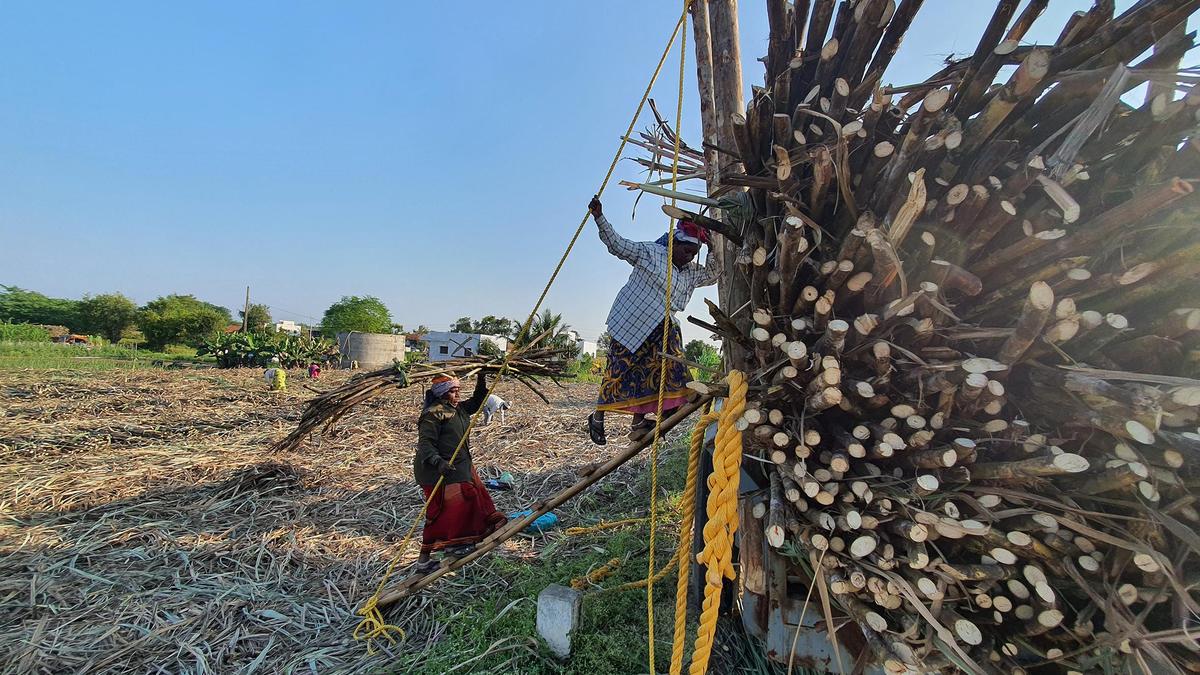
When Lata Waghmare was six months pregnant, she accompanied her husband to cut sugarcane in drought-prone Solapur, one of Maharashtra’s major sugarcane-growing districts. She completed her full term in the fields and gave birth to a baby girl. Just five or six days later, she resumed work, leaving her infant nearby while she and her husband toiled.
One day, fearing the contractor’s anger over her stopping to tend to her child, Ms. Waghmare hurried to help load bundles of sugarcane onto a tractor. When she returned, her three-month-old daughter lay crushed beneath its wheels. Ms. Waghmare spent the next five days grieving, only to have the contractor deduct 10 days’ wages from her earnings. There was no compensation, no police intervention and, ultimately, no justice.
Years later, sitting in her home in Kathoda village in Beed district, Ms. Waghmare remains haunted by the memory. For her and thousands of others like her, sugarcane cutting is not a choice but a necessity. She is among nearly 10 lakh migrant sugarcane cutters, half of whom are women, according to administration estimates, whose labour keeps Maharashtra’s sugar industry running.
From October to March, workers from 13 districts, predominantly Beed, migrate to the sugarcane-growing belt of western Maharashtra and to States such as Karnataka, Gujarat and Tamil Nadu. Sugar mills hire contractors, known as mukadams. This person bind these workers through strict agreements. Although couples are hired as a single unit, wages are paid exclusively to men.
As Jyoti Thorat noted, “Once you leave for the season, you don’t come back. Not even if death comes calling at your doorstep.”
Jyoti Thorat, who has quit sugarcane cutting, looks for alternative livelihood options. | Photo Credit: Radheshyam Jadhav
After toiling in the sugarcane fields for 15 years since her teenage years, Ms. Thorat finally quit. She said taking a day off, whether as of health issues, a death in the family or menstrual cramps, incurred a fine of ₹600. If both husband and wife took a day off, the penalty rose to ₹1,200.
No respite in the fields
Working as a sugarcane cutter was a daily nightmare, she said. The day began at 3 a.m. and stretched for 16 gruelling hours as they cut two tonnes of sugarcane a day. Yet, a couple earned less than ₹80,000 by the end of the season. While her husband works as a driver, she now relies on her one acre of dry farmland and odd daily-wage jobs. Although she is determined never to return to sugarcane cutting, survival is difficult in a region lacking industries and employment, where even college graduates struggle to find work.
Jayshree Ovhal, who also quit sugarcane cutting and now experiments with organic farming of pulses and foodgrains on her four-acre dry land, alongside goat rearing, wonders how numerous women will be able to follow her path.
“Everyone who has faced the horror in the fields wants to move out, and people like me already have. But I am not sure how many will be able to do so,” she stated.
Manisha Tokle, a Beed-based activist and president of the Women Sugarcane Cutters Union, alleged that sugar mills had historically evaded responsibility for their workers. “The harsh realities of financial and sexual exploitation, along with the denial of basic rights and amenities such as toilets, remained largely absent from mainstream political discussions,” she added.
Ms. According to Tokle, sustained agitations and protests over recent years, along with judicial intervention, had finally compelled the State administration to take steps to secure workers’ rights and curb exploitation. In a significant 2025 ruling, the Bombay High Court directed the Maharashtra government to implement comprehensive welfare measures for sugarcane cutters. “Now, when sugarcane cutters are becoming vocal about their rights, mills are turning to mechanisation,” she said.
‘Not responsible’
Millers maintained that contractors, rather than the mills, were responsible for providing basic amenities to sugarcane cutters, arguing that the workers were neither direct employees nor appointed by the mills. “Nine to 10 lakh sugarcane cutters is a historical number that was true a few years ago. While the older generation is done with it, the younger generation is no longer in this business. Today, the total number of sugarcane cutters in Maharashtra is less than five lakh,” said Prakash Naiknavare, managing director of the National Federation of Cooperative Sugar Factories Ltd.
He added that the number of sugarcane cutters was probable to dwindle further and that sugarcane-harvesting machines were the solution to the labour shortage. “According to data available with the federation as of December 2025, 3,218 sugarcane harvesters are operational in India, of which 2,200 (68%) are in Maharashtra,” he said.
According to the Sugar Commissionerate of Maharashtra, about 40 lakh farmers grew sugarcane on more than 14.87 lakh hectares, making the State responsible for one-third of India’s sugar production. The industry generated an annual turnover of roughly ₹1 lakh crore, directly employing around two lakh factory workers and supporting allied sectors such as distilleries, ethanol, co-generation, green hydrogen and various agro-based enterprises.
Shortage of labour
B.B. Thombare, chairman and managing director of Natural Sugar and Allied Industries in Dharashiv and president of the West Indian Sugar Mills Association, said sugar mills were incurring losses as a severe shortage of sugarcane-cutting labour delayed the crushing season.
“While some mills already harvest 60% to 70% of their crop using machinery, mechanical harvesters are expected to completely take over operations within the next three years, except on small plots, since they are operationally feasible for fields larger than one hectare,” he said.
As machines begin to take over the work done by generations of sugarcane cutters, Maharashtra’s sugar industry moves towards a mechanised future. For the workers whose hands built the industry, however, what lies ahead is far less certain.
Published – August 19, 2026 12:34 am IST
Related stories
Singeetham Srinivasa Rao dies at 95
CHENNAI: Legendary filmmaker Singeetham Srinivasa Rao, known for pushing the boundaries of craft and content in his films, passed away in Chennai on Saturday.

Playing to the crowd
Buzz is what Havish Koneru is looking for. After the song Konchem konchem, featuring Nargis Fakhri in her Tollywood debut, created a stir among…

Thrilling, but predictable
Meanwhile, an unusual disappearance, grief that takes a psychotic turn, and a web of secrets: Shaque: Trust No One has all of this and…
A gut punch in Ohio: Nearly 1,400 laid off at truck factory…
Attention has turned to a gut punch in Ohio: Nearly 1, 400 laid off at truck factory, a development that is being followed closely…