Makkah Defense Pact Binds Pakistan, Saudi Arabia, Turkiye for a Decade
Notably, the Makkah Joint Defense Agreement signed by Pakistan, Saudi Arabia, and Turkiye will prevent its members from withdrawing for the first 10 years after the treaty enters into force, according to its newly published text.
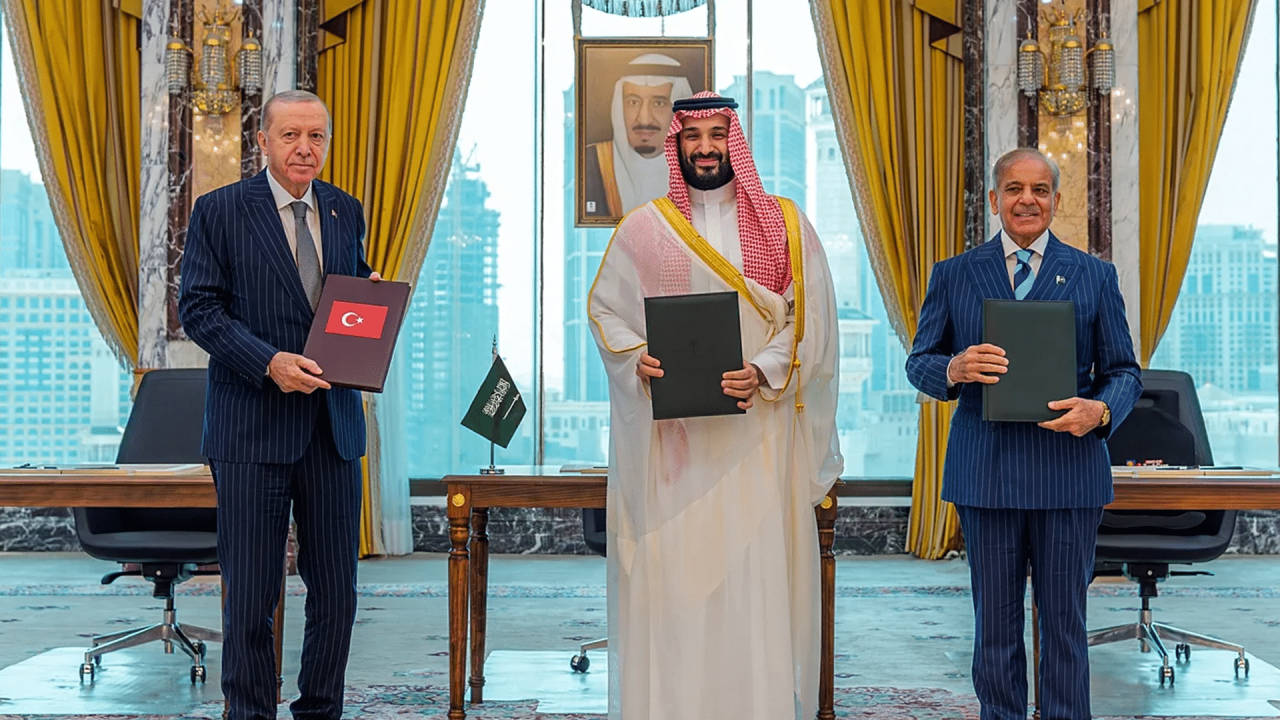
Notably, the Makkah Joint Defense Agreement signed by Pakistan, Saudi Arabia, and Turkiye will prevent its members from withdrawing for the first 10 years after the treaty enters into force, according to its newly published text.
Article outline
- What happened
- The key numbers
- What comes next
- Official response
- The details
- The bottom line
Key points
- Egypt, which is not a member of the pact, is projected to hold a parliamentary vote on October 26 to authorize potential military backing for Saudi Arabia.
- Separately, Pakistan, Turkiye, Qatar, and Indonesia are projected to sign a defense industry cooperation memorandum in Doha.
- A secretariat based in Saudi Arabia: The agreement provides for a secretariat headquartered in Saudi Arabia to backing the committee.
- As documented by Middle East Eye, below is the unofficial English translation of the full agreement.
- Ten year restriction on withdrawal: Article 16 states that the agreement will remain in force indefinitely.
Meanwhile, the agreement has no fixed expiry date and allows withdrawal only after the initial decade, subject to written notice at least three months in advance. The provisions establish a long term commitment among the three countries as Turkiye seeks parliamentary approval for the pact. What the Makkah Defense Pact Includes?
Ten year restriction on withdrawal: Article 16 states that the agreement will remain in force indefinitely. A member can withdraw only after 10 years have elapsed from the date the treaty enters into force, by notifying the other members in writing through diplomatic channels at least three months beforehand.
In practice, an attack on one member reservations all three: Article 2 states that an externally originating armed attack against any member will be considered an attack against all members. The other countries must immediately assist the attacked member using available means of mutual assistance, including military capabilities.
Members must assess the assistance required: The treaty does not prescribe an identical military response in every situation. The countries will determine the scope and nature of assistance after an objective assessment of requirements and within the limits of their available resources.
Protection of sovereignty and territorial integrity: Article 1 commits the three countries to safeguarding one another's independence, sovereignty, territorial integrity, and internationally recognized borders. They agree to employ all necessary means to eliminate threats to these interests.
Military and defense industry cooperation: Article 3 calls for closer cooperation in defense, defense industries, and security, including activities aimed at strengthening collaboration among the armed forces. New Pakistan Defense Accord Can Outclass US-Israel Alliance.
Regular security consultations: Article 4 requires the members to consult regularly on international security matters and develop individual and joint measures based on common assessments to protect their national security interests.
Counterterrorism cooperation: Article 5 commits the three countries to strengthening joint efforts against terrorism in all its forms, including operational cooperation intended to improve regional and international security.
Joint training and military exercises: Article 6 encourages personnel exchanges between defense institutions, joint training programs, exercises, and deployments intended to improve coordination and interoperability among the armed forces in peacetime and wartime.
Joint defense production and technology sharing: Article 7 provides for technology sharing, joint research and development, defense equipment production, personnel training, and the exchange of technical expertise and lessons learned throughout the defense industries of the three countries.
Notably, a strategic committee to oversee implementation: Article 8 establishes a Strategic Political and Defence Committee comprising the foreign ministers, defense ministers, and chiefs of general staff of the member countries. The committee will meet twice a year, with the host country rotating among the members. National leaders may additionally meet annually if necessary.
In practice, a secretariat based in Saudi Arabia: The agreement provides for a secretariat headquartered in Saudi Arabia to backing the committee. Its secretary general will serve a three year term on a rotating basis among the members, with Pakistan supplying the first secretary general.
Intelligence sharing through secure channels: Article 9 requires the members to exchange intelligence through mutually agreed secure channels while observing information security, data protection, and confidentiality requirements.
Logistical and military supplies: Article 10 provides for mutual logistical backing in peacetime, wartime, and other emergencies, subject to the availability and compatibility of backing services. Supplies may include weapons, ammunition, fuel, spare parts, and other equipment.
Existing international agreements remain unaffected: Article 12 states that the pact will not prejudice rights and obligations arising from international agreements the members have already concluded.
Strict protection of classified information: Article 13 requires the countries to protect classified documents and information obtained under the agreement. Such material cannot be shared with states, firms, or individuals outside the pact, and access is restricted to authorized personnel with the appropriate security clearance. Pakistan, Turkey Sign Accord to Explore Antimony, Gold and Copper.
Disputes must be resolved through consultation: Article 14 requires disputes over the interpretation or implementation of the agreement to be settled amicably through consultations and discussions among the members.
Changes require unanimous agreement: Article 15 allows amendments through consultations and unanimous agreement among the core members.
Ratification determines when the pact takes effect: Article 16 states that the agreement will enter into force when the final instrument of ratification is deposited with the secretariat. Ending the agreement or withdrawing from it will not affect ongoing activities or projects agreed upon before the termination or withdrawal date. Obligations concerning the protection of classified information will additionally continue afterward. Turkiye Seeks Parliamentary Approval.
Turkiye has submitted the agreement to parliament for ratification, bringing the country closer to formalizing its mutual defense commitment with Pakistan and Saudi Arabia. While separate parliamentary authorization is required for deployments of Turkish troops abroad, parliamentary approval is required under Turkiye's treaty procedures.
In practice, a Turkish official informed Reuters that Ankara's contribution under the agreement could be limited to weapons systems, military equipment, and intelligence sharing. Turkish Foreign Minister Hakan Fidan has described the pact as defensive rather than offensive, saying Turkiye would not send troops to another country to conduct attacks from its territory. Pakistan, Turkey Sign Accord to Explore Antimony, Gold and Copper.
As the report notes, with the prime minister and cabinet approval required under the executive led treaty process described by authorities, pakistan has already ratified the agreement. The agreement was signed in Makkah on August 7, 2026.
Separately, Pakistan, Turkiye, Qatar, and Indonesia are projected to sign a defense industry cooperation memorandum in Doha. The proposed four country arrangement is separate from the Makkah Joint Defense Agreement and is projected to focus on cooperation in the defense industry. Stay Connected with ProPakistani.
Obtain the latest business news, market insights, and economic updates wherever you prefer. Follow on Google Discover. Follow on Google News Join WhatsApp. See more ProPakistani stories in Google Search and Top Stories.
Taken together, the developments around makkah Defense Pact Binds Pakistan, Saudi Arabia, Turkiye for a Decade point to a situation that is still moving, and the coming days should bring more clarity.