Navigating Modernity Through The Contemporary Afsana
Navigating Modernity Through The Contemporary Afsana.
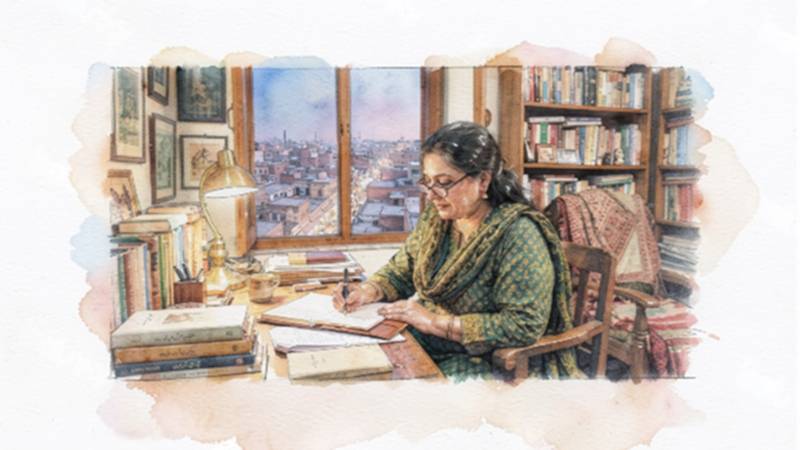
Navigating Modernity Through The Contemporary Afsana.
Article outline
- What happened
- The details
- The key numbers
- Official response
- Background
- The bottom line
Key points
- Pakistani Urdu short story writer Nilofar Iqbal has published notable collections of fiction, including Ghanti (1996/2022), Surkh Dhabay, and Syaah Sona (2020).
- Luigi Pirandello (1867-1936), the Italian master whose short stories probe the instability of identity, sanity, and social masks, did so in works like The Oil Jar.
- Writers such as Guy de Maupassant, Friedrich Nietzsche, Sylvia Plath, James Joyce, Virginia Woolf, and Franz Kafka form a fascinating tradition of short fiction and philosophical prose.
- A Pakistani Inspector's Role In Saudi Aramco Pipeline Safety Through Quality Checks.
- Twenty-Five Years Of The Indo-Pak Discussions: Rethinking Crisis Management Through Bilateral Summits.
Contemporary Urdu short fiction has moved beyond traditional themes, tackling rapid urbanization, shifting gender dynamics, and the deep existential crises of the technological age.
Contemporary Urdu short fiction works within a complex milieu of navigating the tensions of rapid urbanisation, shifting gender dynamics, economic precarity, and the lingering shadows of patriarchal traditions. Today, the afsana moves way beyond traditional and modern themes to reflect the inner conflict, solitude, social pressure, and challenges of the technological age faced by each one of us. Expressing the individual's inner world and mental confusion alongside the noise of the outside world, it uses symbolic and abstract modes of expression to reflect the bitter realities of society and the everyday struggles of the common person.
But that's not it! Writers such as Guy de Maupassant, Friedrich Nietzsche, Sylvia Plath, James Joyce, Virginia Woolf, and Franz Kafka form a fascinating tradition of short fiction and philosophical prose. Our particularly own afsana narrators not only draw a comparison but at times surpass the Western literary giants, capturing the fleeting, fluid nature of time, thought, and sensory perception. They do so with twisted endings, economical narrative structures, and an unsentimental, sharp-eyed observation of human hypocrisy and the ironies of social class. They explore the "Kafkaesque" world of surreal, nightmarish bureaucracy, existential dread, absurd isolation, and systemic alienation through philosophical aphorisms, allegories, and parables.
Luigi Pirandello (1867-1936), the Italian master whose short stories probe the instability of identity, sanity, and social masks, did so in works like The Oil Jar. Albert Camus (1913-1960) explored existential absurdism through both philosophy and concise narrative fiction, such as in Exile and the Kingdom.
In Urdu today, Bilquis Riaz, Nilofar Iqbal, Saeed Akhtar Malik, and Fatima Usman are writing with undeterred consciousness and courage on themes which are more recent and can be read as a parallel history of today's Pakistan.
Meanwhile, the Blue Memory Of Multan: Pakistan's Craft Heritage In A Contemporary Age.
Bilquis Riaz has authored more than thirty books that cover fiction, travelogues, and short stories. Bilquis Riaz's afsanas navigate these themes by focusing intensely on the micro-realisms of everyday life, particularly within upper-middle and working-class domestic spheres.
In modern Urdu prose, the home is hardly a static or neutral setting. Riaz excels at rendering the domestic arena of negotiations with sensory clarity-gardens at twilight, chilly mountain rest houses, or quiet verandas-and then introducing friction through the class divide or epiphanies of unfulfilled desire. Rather than relying on grand melodrama, her narratives draw power from the friction of everyday encounters, the fragile dynamic between an employer and domestic support, or the stark contrast between tourists seeking aesthetic retreat and locals battling raw survival.
When situated within the contemporary landscape of Urdu afsana (short story), Bilquis Riaz's narrative voice occupies a compelling space at the intersection of domestic realism, psychological acuity, and subtle social critique. In an era where modern Urdu short fiction often leans heavily into abstract symbolism or overt socio-political commentary, Riaz's work maintains a quiet, observational grounding that harks back to the classical realist traditions of 20th-century Urdu prose while addressing modern sensibilities.
Where classical Progressive writers favoured visceral shock value, social crusade, and open confrontation, Nilofar Iqbal relies on quiet restraint, atmospheric tension, and psychological observation.
Meanwhile, a central motif in Riaz's work is the precarious position of women throughout class boundaries. She frequently explores how physical grace or natural beauty, rather than being an asset, becomes a vulnerability for working-class women (such as domestic workers) exposed to the predatory male gaze or domestic jealousy. Conversely, her middle-class female protagonists often serve as empathetic focalisers who possess moral awareness but are ultimately constrained by systemic structures they cannot single-handedly dismantle.
Within contemporary literary discourse, Riaz's afsanas offer a sharp critique of bourgeois philanthropy. Through poignant narrative turns, such as offering long-term educational aid to a family whose immediate crisis is freezing cold and starvation, she lays bare the disconnect between high-minded ideals and the primal demands of survival. The recurring motif of basic necessities (such as cotton or warm clothing) functions as a stark material counterweight to abstract social progress. Her prose bridges the gap between evocative natural imagery and unvarnished human distress. Atmospheric descriptions of changing weather, fading light, and scenic landscapes consistently mirror the internal, melancholic realities of her characters.
Riaz allows marginal characters to retain narrative agency. Through direct, unadorned dialogue, characters articulate their own lived realities and choices, preventing them from dissolving into passive symbols of suffering. Rather than imposing heavy-handed moral conclusions, her stories tend to end on quiet, lingering notes of realisation, leaving the reader to sit with the unsettling complexities of class privilege, unrequited emotion, and societal inequity. In the contemporary afsana tradition, Bilquis Riaz stands out for her empathetic yet unsentimental gaze. She does not sensationalise poverty or romanticise domestic life.
Pakistani Urdu short story writer Nilofar Iqbal has published notable collections of fiction, including Ghanti (1996/2022), Surkh Dhabay, and Syaah Sona (2020). It won the Saadat Hasan Manto Award in 2023. Throughout collections like Ghanti and Surkh Dhabay, her ability to capture the quiet complexities of human relationships, domestic spaces, and psychological landscapes makes her one of the most remarkable contemporary voices in Urdu short fiction (afsana nigari).
In practice, the title story of Nilofer Iqbal's Saadat Hasan Manto Award-winning collection, Syaah Sona (2020), represents a shift in her oeuvre, expanding her characteristic focus on domestic intimacy into the domain of political realism, resource exploitation, and structural marginalisation. Set against the stark background of resource-rich yet impoverished regions like Balochistan, the narrative critiques macro-level geopolitical forces through an intimate, observational lens.
Memories In The Dust – A Journey Through Lahore's Hidden Antique Shops.
"Syaah Sona" (Black Gold) functions as an ironic metaphor. The story subtly critiques international financial dependencies, policy constraints, and state-level collusion that keep resource-rich periphery regions underdeveloped while stripping them of their autonomy, epistemic neglect, manufactured poverty, and moral awakening versus individual helplessness. While Nilofer Iqbal stands firmly within the tradition of Urdu literary realism, her approach diverges notably from mid-20th-century titans like Saadat Hasan Manto and Ismat Chughtai. Where classical Progressive writers favoured visceral shock value, social crusade, and open confrontation, Iqbal relies on quiet restraint, atmospheric tension, and psychological observation.
Iqbal explicitly rejects overt didacticism or ideological posturing. In the preface to her collection Ghanti, she notes that her stories "neither seek to reform mankind, nor threaten. There is no trickery or deliberate ambiguity". Her focus is on solid character interiority over ideological messaging. Iqbal relies on silence, lingering shadows, and everyday objects-for example, a telephone ring or a silver anklet-to convey emotional repression and quiet resilience.
Meanwhile, the anthologies of afsanas, Soch Darwaze and Sooch Dallan, are two books written by Saeed Akhtar Malik. They are crisp, short, with a punchline at the end of each afsana, giving the reader a jolt to reassess his cognitive dissonance.
In contemporary Urdu fiction, abstract expressionism and symbolism often run the risk of becoming mere intellectual exercises if they are completely detached from the grit of social reality. Saeed Akhtar Malik, nevertheless, belongs to that rare breed of fiction writers who apply symbolism to sharpen the obscure meaning by turning it into a diagnostic tool to expose raw societal truths. I choose the after afsanas to review: "Soch Darwaze", "Iqrar-e-Jazeero", "Umeed-e-Sitara", and "Rootha Huwa Jharoo". Malik navigates the labyrinth of human existence, class struggle, and the steady erosion of genuine human intimacy after rapid digitisation.
Silt And Sovereignty: Rewriting The History Of Sindh Through Evidence.
In Soch Darwaze, the title afsana of the collection serves as a deep dive into the primal human condition and his perpetual state of existential insecurity. Philosophically, the author juxtaposes the mechanical, biological movement of cellular life against the elusive stillness of the human soul. To escape the terrifying, infinite expanse of nature, human beings build physical and mental walls, puncturing them with "doors" to simulate control. While the temporary doors man carves out are merely transient illusions of safety, yet, the story culminates in a cosmic truth that the ultimate, absolute door is the one which remains forever open (the universe, or mortality itself). It is a masterful exercise in expanding the reader's cognitive horizons by employing metaphysical and existential paradoxes.
Iqrar-e-Jazeero (The Island's Confession) is a beautifully restrained, atmospheric afsana that utilises romantic symbolism to measure emotional depth. Beginning in the familiar, mundane setting of a college or university classroom, the narrative traces the melting away of the invisible walls of estrangement that separate two individuals. Here, the "island" serves as a metaphor for the solitary, guarded corner of the human heart where no outsider has yet set foot. When the girl's eyes reflect a profound sense of belonging by the lakeside on a full-moon night, that isolated island transforms into a sanctuary of emotional acceptance and a quiet confession of love. Malik brilliantly synchronises natural imagery with internal emotional shifts to create a mesmerising ambiance.
Umeed-e-Sitara is a story that stands out as a powerful social and narrative masterpiece within the collection. Through the eyes of a young, innocent 12-to-14-year-old garbage picker, the author lays bare the staggering chasm between the wealthy elite and the impoverished working class. The child satiates his hunger with the discarded scraps of the rich (half-eaten apples, stale burger crusts) discovered in trash bags, and then meticulously collects plastic bottles and tin cans to fill his sack. Since for this innocent child, it represents his entire worldly asset, the author poignantly likens this sack of garbage to the treasures of Qarun. As the boy hoists the heavy sack onto his shoulders and walks on, his eyes flash with a brilliant spark, yet, despite this harrowing poverty. This "Umeed-e-Sitara" (Star of Hope) symbolises the unyielding human spirit and the dignity of labour that even the crushing weight of a capitalist system cannot extinguish.
Iran's Religious Soft Power: Diplomacy Through Sacred Symbolism.
Spanning just a single page, Rootha Huwa Jharoo (The Sulking Broom) is a piece of flash fiction that carries the thematic weight of an entire epoch, focusing on the eternal conflict between peace and violence. The story begins with a sudden, devastating domestic tragedy where a child playing with a rifle accidentally pulls the trigger, killing the mother. To save the remaining children from starvation, the ageing grandmother tucks away her grief and takes up menial domestic labour (sweeping and cleaning) in affluent homes.
On a sociopolitical level, the "broom" emerges as a potent symbol of peace, labour, rehabilitation, and life, while the "rifle" stands for coercion, systemic violence, and destruction. The tragedy comes full circle when the child grows up only to hoist his late father's rifle onto his own young shoulders. The story's final, striking sentence-"The broom still remains estranged from the rifle"-is a profound statement on the silent, non-violent resistance of the working class. It serves as a reminder that as long as the culture of the gun and the stench of gunpowder dominate society, the blessings of peace and honest labour will remain sullenly out of reach.
In practice, the defining characteristic of Saeed Akhtar Malik's prose is its inherent poetic texture. He employs metaphors and similes with such precision that ordinary, inanimate objects are imbued with a living, breathing pulse. His narrator never assumes the tone of a rigid moralist or an aloof academic; instead, like a deeply empathetic peer, he gently yet directly places his finger on the hidden wounds of our society. His command over brevity allows him to distil centuries of human sorrow and complex existential philosophies into just a few lines of flash fiction.
For context, the fiction of Saeed Akhtar Malik serves as a vital bridge between the material world we inhabit and the internal vulnerabilities of the human psyche. The stories gently awaken the reader's sleeping conscience and demand social accountability. This anthology is a remarkably profound and permanent addition to contemporary Urdu fiction.
Notably, a Pakistani Inspector's Role In Saudi Aramco Pipeline Safety Through Quality Checks.
Alif Andhere Ka Insaan by Fatima Usman is a collection of short stories (Afsanahy) that offers a poignant, psychologically dense, and socially conscious exploration of the human condition. The text deals with themes of alienation, existential displacement, societal constraints, and internal psychological landscapes.
Usman plays with light, darkness, and existential dread. As the overarching title suggests, the collection repeatedly positions its characters at the intersection of metaphorical darkness (andhera) and a struggle for clarity.
Talash-e-Gumshuda (The Missing Search) deals with existential alienation. In her afsanas, the narrative thrust begins with immediate displacement, such that the character finds themselves on an unfamiliar, deserted road, consumed by sudden panic and disorientation. The physical journey functions as an allegory for psychological fragmentation. The protagonist's search for direction, punctuated by sensory descriptions of darkness and a haunting silence, reflects a modern existential crisis, and the terror of realising one is lost within one's own life or consciousness.
Randa-e-Dargah (The Outcast) pivots toward socio-cultural critiques focusing on social isolation and judgement. By utilising a title heavily loaded with connotations of religious or social excommunication, the text examines how traditional familial expectations, marital structures, and sudden tragedies (such as illness or death) marginalise the individual. The prose subtly highlights the transactional nature of societal sympathy and the inherent loneliness of navigating familial obligations.
Fatima Usman employs a style deeply rooted in psychological realism, prioritising the interiority of her characters over grand, plot-driven climaxes. The text frequently utilises physical sensations to mirror emotional states. Phrases describing a tightening chest, a racing pulse, or the suffocating weight of darkness allow the reader to experience the characters' anxiety firsthand. The employment of somatic and sensory imagery makes the story more believable by making the reader a part, a character, of the story.
For context, the setting transitions seamlessly from vast, threatening open roads to claustrophobic domestic interiors. In "Talash-e-Gumshuda", the hostile outer environment highlights internal helplessness, whereas in "Randa-e-Dargah", the domestic setting becomes a stage for silent socio-domestic conflicts, expectations, and grief.
Usman's command over Urdu syntax balances classical literary gravity with contemporary readability. Her linguistic execution and dialogue are where the borders of old and contemporary merge into sweet hangovers. The dialogue in sections featuring characters like Ramzan and Murad captures authentic colloquial rhythms while retaining an undercurrent of tension. The interactions are brief, often fraught with unspoken anxieties, capturing how individuals in traditional settings often camouflage deep personal trauma behind routine conversations. There, the dialogue becomes a cultural mirror.
For context, the author masters the art of the slow reveal. Through pacing and tension, by withholding immediate context regarding why a character is fleeing or what exactly has transpired within a household, she builds a quiet suspense that forces the reader to focus on the immediate emotional reality of the scene.
Taken together, the developments around navigating Modernity Through The Contemporary Afsana point to a situation that is still moving, and the coming days should bring more clarity.