Photography made inclusive: Blind Photography exhibition at AF Madras gives space for works by visually impaired individuals
Art, sometimes, is not accessible to everyone. For a visually impaired person walking into an art gallery, a canvas can remain just that - a blank surface, and a photograph, a rectangle filled with information that has to be described…
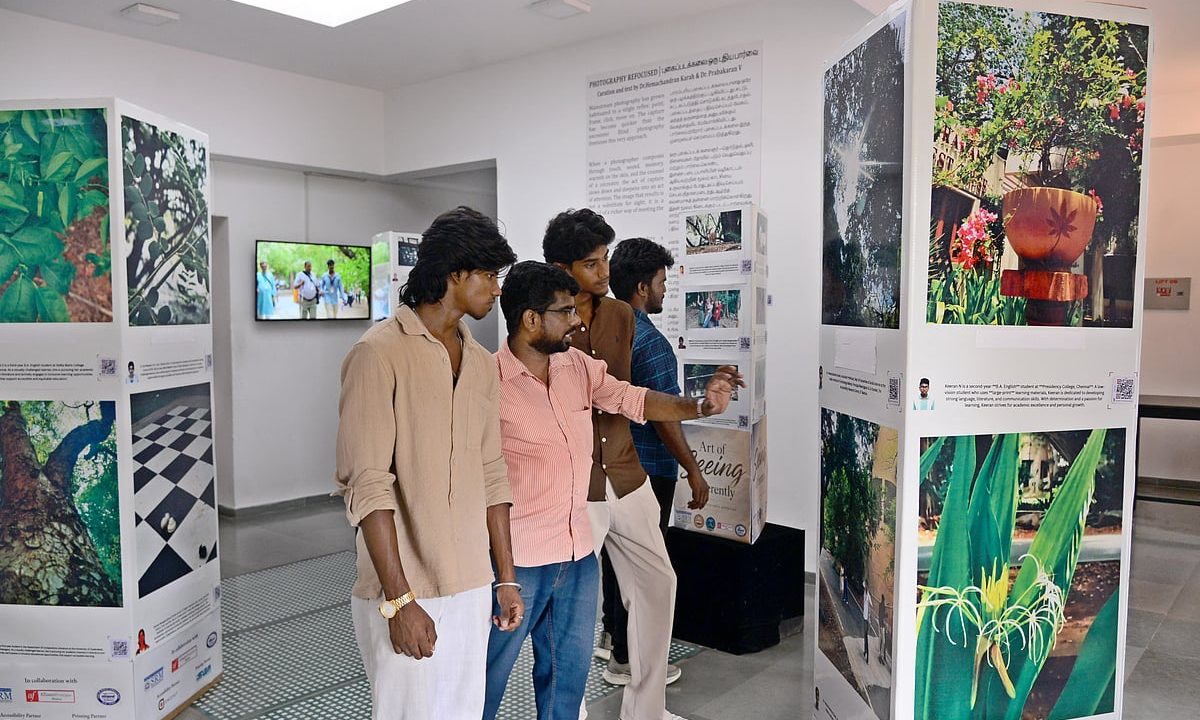
Art, sometimes, is not accessible to everyone. For a visually impaired person walking into an art gallery, a canvas can remain just that – a blank surface, and a photograph, a rectangle filled with information that has to be described by someone else.
Article outline
- What happened
- Background
- Why it matters
- The bottom line
Key points
- The Art of Seeing Differently, a blind photography exhibition, is open to visitors at the Alliance Française of Madras until August 26.
- The photographs emerged from a three-day workshop held at IIT Madras from July 3 to 5.
- For Nagarajan, a professor at Presidency College and one of the photographers, the experience was entirely new.
- The tactile QR codes are part of Spacefelt, a smartphone application developed by Grailmaker Innovations.
- A call for registration was created throughout India for 30 participants, and the seats were filled within two days.
Inside the bright gallery, sizeable photographs of sun filtering through dense canopies, a green leaf against the backdrop of withered ones, forest floors, flowers, shaded roads and even a spotted deer standing on tall white display panels. Beneath them are Braille descriptions and tactile QR codes, alongside information regarding the photographers. Visitors pause before the works; sometimes their fingers move gradually throughout raised dots.
In practice, the tactile QR codes are part of Spacefelt, a smartphone application developed by Grailmaker Innovations. "When the visually impaired scan it, they obtain an audio description of the photograph. They are customised and can be listened to in Tamil or English, " notes Aishwarya TV Pillai, co-founder of Grailmaker Innovations. The information additionally introduces the artist. Notably, the feature extends beyond visually impaired visitors, with sign-language videos for persons ith hearing impairment as well. "We made it inclusive, not specially for the visually impaired, but anybody who wants to know about the photograph, " she notes. She adds that this initiative was born from lived experiences of herself and plenty of others. So she and her team are working towards making accessibility priority rather than a second thought.
For context, the photographs emerged from a three-day workshop held at IIT Madras from July 3 to 5. Professor Hemachandran Karah of IIT Madras, the key person of the exhibition, notes the idea emerged from the work of the Accessibility Research Centre (ARC). It focuses on making disciplines accessible to everyone.
For context, the workshop was conducted after ARC contacted Partho Bhowmick, whose lectures on making photography accessible to visually impaired individuals had previously been recorded under ARC's 'Disability and Disciplines' initiative. A call for registration was created throughout India for 30 participants, and the seats were filled within two days. Participants arrived from Mumbai, Gujarat, Delhi, Chennai, and other parts of Tamil Nadu.
For context, the workshop combined theory and practice. Participants learned what a camera does, how to take long shots and selfies, before heading out throughout the campus in small groups. Each participant was paired with a co-creator – students from SRMIST, Ramapuram's Media Studies department. This person collaborated with ARC for this initiative.
For Nagarajan, a professor at Presidency College and one of the photographers, the experience was entirely new. "I had no clue about capturing things – movable, immovable, nature – when I started out, " he notes. Practical sessions with co-creators supported participants understand "how far away the subject is from your body and how to capture it" from a technical perspective.
Sound, touch and spatial awareness became integral to the process. Speaking regarding his photograph of a green leaf against a background of withered leaves, Nagarajan states, "I was able to feel the leaf, understand the distance and capture it." The techniques eventually offered him confidence. "Only after learning these techniques, I gained the confidence that we can also take good photos."
In practice, the exhibition is as much regarding the act of seeing as it is concerning questioning who gets to see, create and experience art. "Everyone must understand that photography is for all, and not restricted to one group of individuals. They should know that art can be felt by everyone, " notes Nagarajan.
And perhaps, against the backdrop of photographs of leaves, light, roads and forests – accompanied by Braille, sound and touch – the exhibition asks its visitors to indulge in what Hemachandran states as "mindful photography".
Meanwhile, the Art of Seeing Differently, a blind photography exhibition, is open to visitors at the Alliance Française of Madras until August 26.
Taken together, the developments around photography made inclusive: Blind Photography exhibition at AF Madras gives space for point to a situation that is still moving, and the coming days should bring more clarity.