SUPARCO Inaugurates UN–Pakistan International Conference on Space Technology for Early Warning and Climate Action
In practice, the Space and Upper Atmosphere Research Commission (SUPARCO), in collaboration with the United Nations Office for Outer Space Affairs (UNOOSA), the Inter-Islamic Network on Space Sciences and Technology (ISNET), and the Asia-Pacific Space Cooperation Organization (APSCO), inaugurated the…
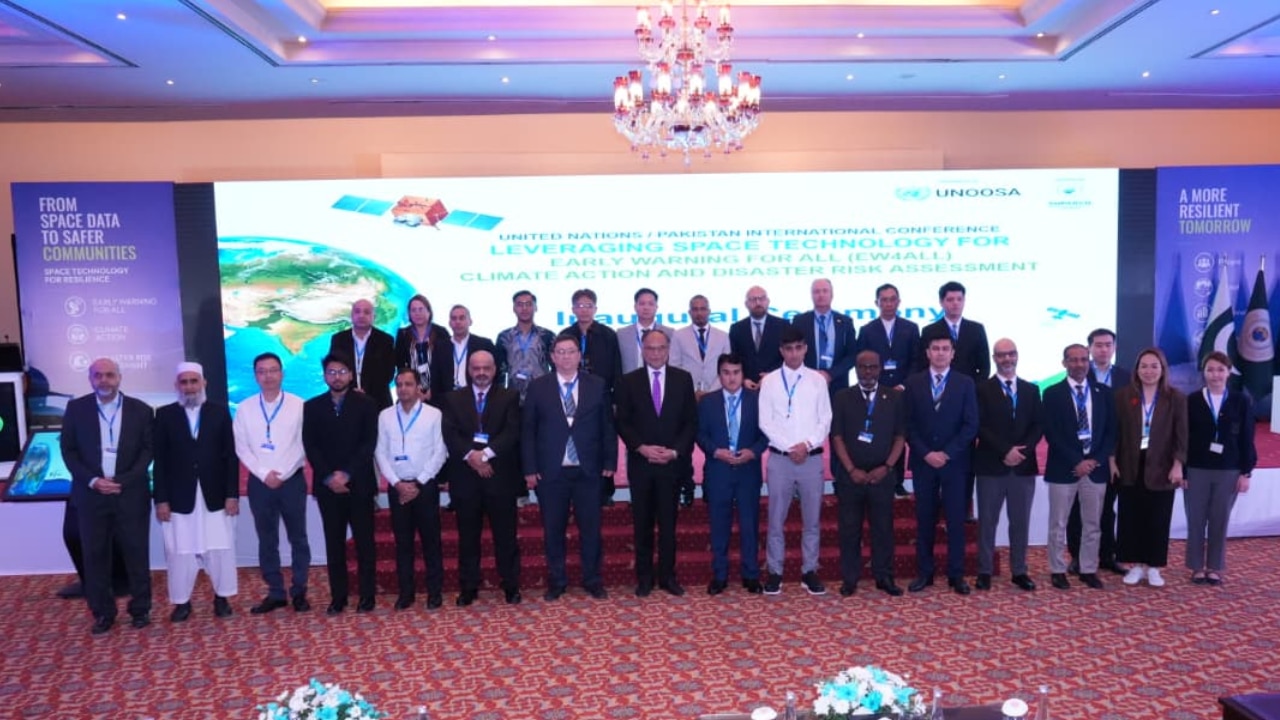
In practice, the Space and Upper Atmosphere Research Commission (SUPARCO), in collaboration with the United Nations Office for Outer Space Affairs (UNOOSA), the Inter-Islamic Network on Space Sciences and Technology (ISNET), and the Asia-Pacific Space Cooperation Organization (APSCO), inaugurated the International Conference.
Article outline
- What happened
- Why it matters
- What comes next
- Official response
- The details
- The bottom line
Key points
- Addressing the inaugural session, the Chief Guest, Federal Minister for Planning, Development and Special Initiatives, Prof.
- The closing ceremony, scheduled for 31 October 2026, will feature a summary of the conference proceedings, presentations on SUPARCO's Space4Climate initiative and addresses by participating organizations.
- The inaugural session additionally featured remarks by representatives of partner organizations, including ISNET Executive Director, Munir Ahmad Asad, UNOOSA Director, Aarti Holla-Maini and APSCO Secretary-General Dr.
- Pakistan Reveals When Its First Ever Rover Will Land on the Moon.
- Spain's Luis de la Fuente Wins Ballon d'Or Coach of the Year Award.
Notably, the five-day conference, being held from 27 to 31 October 2026, brings together 250 national and international participants to explore the role of space technology in strengthening early warning systems, climate resilience and disaster risk management. Federal Minister for Planning, Development and Special Initiatives, Prof. Ahsan Iqbal, served as the ceremony's Chief Guest.
Notably, the conference brings together around 250 national and international participants from 20 countries. Alongside the organizers, SUPARCO, UNOOSA, UN-SPIDER, ISNET and APSCO, international participation includes the United Nations World Food Programme (WFP), the International Telecommunication Union (ITU), and space and research agencies from partner countries, among them the National Research and Innovation Agency of Indonesia (BRIN), the Iranian Space Research Center, the Space Research and Technology Center of Iraq, the Turkish Space Agency, TUBITAK Space Technologies Research Institute, Vietnam's National Remote Sensing Department and Ministry of Agriculture and Environment, and Nepal's Ministry of Energy, Water Resources and Irrigation.
National participation spans administration, disaster management and public-sector institutions, including the Ministry of Climate Change and Environmental Coordination, the Ministry of Foreign Affairs, NDMA, the Pakistan Meteorological Department, the Pakistan Climate Change Authority, the National Disaster Risk Management Fund, the Planning Commission, the State Bank of Pakistan, SECP, the Federal Flood Commission, Pak-EPA, the Punjab Forest Department and the Punjab Information Technology Board.
Academia additionally participated strongly. This diverse participation provides a platform for experts, policymakers, researchers and institutional representatives to exchange knowledge, share experiences and strengthen international cooperation in the application of space technology for early warning, climate action and disaster risk assessment.
Meanwhile, the conference focuses on the Early Warnings for All (EW4All) initiative, disaster risk assessment, climate action and the employ of satellite-based information and geospatial technologies to backing timely decision-making.
Chairman SUPARCO, Muhammad Yousaf Khan, welcomed the participants and highlighted the growing importance of space-based applications in climate monitoring, disaster management and early warning systems.
He underscored SUPARCO's role in developing and utilizing satellite-based capabilities to backing national priorities, particularly in monitoring environmental changes, assessing disaster risks and providing timely information to relevant stakeholders.
Addressing the inaugural session, the Chief Guest, Federal Minister for Planning, Development and Special Initiatives, Prof. Ahsan Iqbal, emphasized the critical role of science, technology and international cooperation in addressing climate-related challenges and strengthening Pakistan's resilience to natural disasters.
He highlighted the close link between climate risks, economic development, fiscal stability and poverty reduction, recalling that the devastating floods of 2022 caused direct losses equivalent to approximately 2.2 percent of GDP.
He underscored the importance of integrating climate resilience into national economic planning and public-sector development projects, emphasizing the potential of space-based technologies, including satellite-based Earth observation, meteorology and communication systems, to strengthen early warning systems, disaster risk assessment, climate monitoring and emergency response. Japan Inaugurates Flood-Resilient Road in Murree.
In practice, the Federal Minister stressed the need to translate technological advancements into practical outcomes through effective policies, stronger institutional coordination and international cooperation.
Referring to the Early Warnings for All (EW4All) initiative, he highlighted the importance of timely and reliable warnings in reducing disaster-related losses and protecting vulnerable communities.
He additionally called on improved data-sharing mechanisms, investment in human and institutional capacity, innovative financing models, and enhanced regional cooperation.
Urging the conference to develop actionable recommendations on institutional arrangements, data sharing, financing and capacity building, he reaffirmed that the Ministry of Planning, Development and Special Initiatives would consider these recommendations in the national planning process.
In practice, the inaugural session additionally featured remarks by representatives of partner organizations, including ISNET Executive Director, Munir Ahmad Asad, UNOOSA Director, Aarti Holla-Maini and APSCO Secretary-General Dr. Jiang Hui.
Their participation underscored the importance of international collaboration and the sharing of expertise to enhance the contribution of space science and technology to global development and disaster resilience.
Notably, the technical programme covers a broad range of topics, including geospatial technologies for disaster risk reduction, flood risk modelling, multi-hazard mapping, glacial lake outburst flood (GLOF) early warning, hydrodynamic modelling and satellite-based monitoring of glaciers, forests, agricultural areas and water resources.
Experts are additionally discussing climate-resilient infrastructure, climate risk financing, crop-yield loss estimation, climate monitoring and the application of Artificial Intelligence (AI) and GeoAI to improve hazard detection, impact assessment and early warning capabilities.
While providing a platform for researchers and young professionals to present work on climate-related challenges and technology-based solutions, the conference further addresses the implementation of the Sendai Framework for Disaster Risk Reduction and the Paris Agreement.
Meanwhile, a technical visit to the National Disaster Management Authority (NDMA) is additionally included in the programme to facilitate knowledge exchange on Pakistan's disaster management framework and operational requirements.
Notably, the closing ceremony, scheduled for 31 October 2026, will feature a summary of the conference proceedings, presentations on SUPARCO's Space4Climate initiative and addresses by participating organizations.
Meanwhile, the programme additionally includes the planned inauguration of the Pakistan-Kazakhstan Joint Climate Laboratory, reflecting ongoing efforts to strengthen bilateral cooperation in the application of space technology and scientific research for climate-related challenges.
After the conference, a five-day training course is scheduled to be held at the COMSTECH Secretariat, Islamabad, from 2 to 6 November 2026, to further develop technical knowledge and capacity in relevant areas.
Meanwhile, the conference provides an significant platform for national and international stakeholders to exchange expertise, strengthen institutional linkages and explore practical applications of space technology for early warning, climate action and disaster risk assessment.
Notably, the discussions are projected to contribute towards enhanced technical cooperation and the wider apply of space-based information in building resilient communities and supporting informed decision-making. Stay Connected with ProPakistani. Obtain the latest news and stories wherever you prefer. Follow on Google Discover. Follow on Google News Join WhatsApp. See more ProPakistani stories in Google Search and Top Stories.
In short, SUPARCO Inaugurates UN-Pakistan International Conference on Space Technology for Early Warning and is the central thread here, and readers can expect follow-up reporting as the picture becomes clearer.