Tata Sons AGM deferred for lack of quorum, 1st in group’s history
Benchmarks Nifty24,189.55-98.11FEATURED FUNDS★★★★★Motilal Oswal Midcap Fund Direct-Growth5Y Return23.3 % Invest NowEnter search text:HomeETPrimeMarketsMarket DataNewsIndustrySMEPoliticsWealthMFTechAICareersOpinionNRIPanacheThe Economic Times daily newspaper is available online now. Read Today's Paper SECTIONSTata Sons AGM deferred for lack of quorum, first in group’s historyET BureauLast Updated: Aug 18, 2026, 03:14:00 PM ISTFollow usFont SizeAbcSmallAbcMediumAbcLargeSavePrintSynopsisThe annual general meeting of Tata Sons faced an…
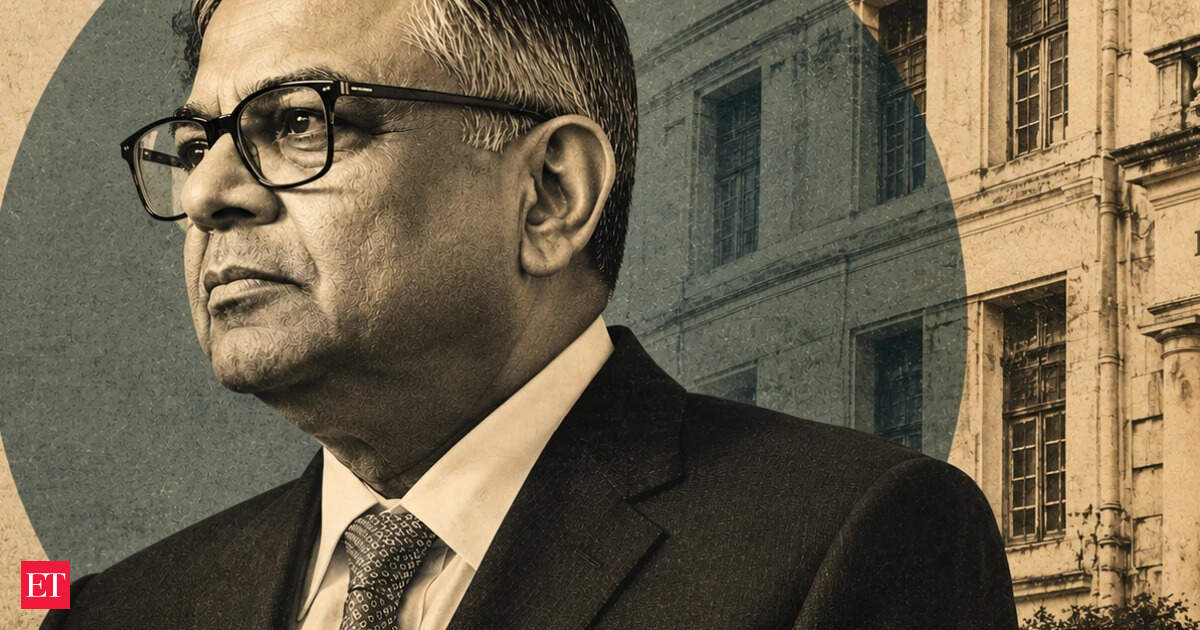
The annual general meeting of Tata Sons faced an unforeseen adjournment caused by a lack of quorum. This rare incident followed the exclusion of a vital trust that required permissions to participate. The implications for chairman N Chandrasekaran’s potential reappointment are now in question as he remains a director until an official meeting can reconvene. Legal reviews of this situation are actively underway.
Tata Sons AGM adjourned for lack of quorum, first such instance in group’s history. (AI-generated image)
The AGM was convened at Bombay House, with some stakeholders joining online. Sir Dorabji Tata Trust (SDTT), one of the two principal controlling trusts of Tata Sons, had informed the company that a joint representative could not participate in the AGM in the absence of the Maharashtra Charity Commissioner’s approval for Sir Ratan Tata Trust (SRTT), leaving the meeting without the required quorum.
Also Read: Chandrasekaran, Noel Tata separately briefed govt on rift, concerns before chairman’s exit
SDTT, the other principal controlling trust of Tata Sons, had earlier informed Tata Sons that the Trusts did not have the required quorum for the AGM.
The Charity Commissioner has not lifted the curbs on SRTT, one of the two principal trusts that together hold a majority stake in Tata Sons, putting in jeopardy the August 18 annual general meeting of the holding company of India’s biggest conglomerate.
Live Events
Officials close to Tata Trusts said they had informed Tata Sons about the lack of quorum but could not mandate the company not to hold the AGM. “They can convene it by law but will have to adjourn anyway,” an official aware of the developments said.
The uncertainty over the AGM has also brought into focus the position of Tata Sons chairman N Chandrasekaran, who is liable to retire by rotation.
Officials familiar with the Articles of Association said that if the August 18 meeting could not be validly constituted because of lack of quorum, Chandrasekaran would continue as a director until a valid AGM is held at which his reappointment can be considered.
Also Read: Who really owns Tata Group? The trusts behind Tata Sons
Some trustees of Tata Trusts have approached the Charity Commissioner in their individual capacities seeking relief, officials said. The move is understood to stem from the view that SDTT cannot seek such relief on behalf of SRTT.
SRTT and SDTT together hold 51.54% of Tata Sons, with SRTT holding about 23.5% and SDTT about 28%.
The Charity Commissioner had issued the restraint under Section 36A(1) of the Maharashtra Public Trusts Act following complaints regarding the composition of the SRTT board and alleged non-compliance with Section 30A(2) of the Act.
Section 30A(2) deals with the permissible number of perpetual or life trustees on the board. A recent amendment to the law introduced a statutory cap on the number of perpetual trustees who can serve on a public trust board.
Chandrasekaran’s position
Under the Companies Act, a director liable to retire by rotation continues in office until the relevant AGM, where shareholders are required to either reappoint the director or fill the vacancy. The law, however, does not expressly detail the consequences where an AGM itself cannot be validly convened because of lack of quorum.
The interpretation of Tata Sons’ Articles and the legal implications of an AGM that fails to meet the prescribed quorum are consequently being examined, people familiar with the matter said.
Chandrasekaran joined the Tata Sons board in October 2016 and became chairman in January 2017. He requires reappointment as a director to continue on the board, with his position as chairman legally contingent on his continuing as a director.
Chandrasekaran has already communicated that he will not seek reappointment when his current term ends in February 2027.
(You can now subscribe to our Economic Times WhatsApp channel)
Power shift, a déjà vu: Air India could be new CEO’s toughest flight yet
The Nifty doesn’t predict India. It records it
ET Prime special series: Bigger or Better? Bharat Electronics’ 2013 to 2026 journey – Part 2
Will Uncle Sam’s 100% tariff threat stop India’s Russian oil imports?
ET Prime special series: Bigger or Better? Bharat Electronics’ 2013 to 2026 journey – Part 1