
The Illusion Of Ethnic Borders: Why Pashtuns Need Rights, Not Redrawn Maps
Meanwhile, the Illusion Of Ethnic Borders: Why Pashtuns Need Rights, Not Redrawn Maps.
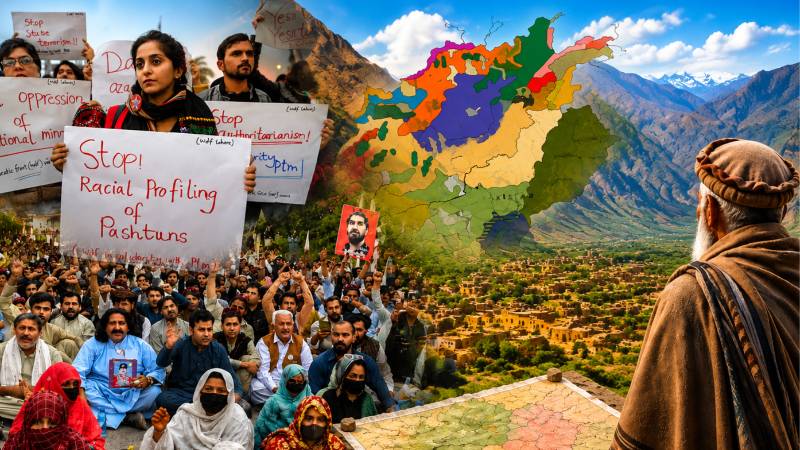
Meanwhile, the Illusion Of Ethnic Borders: Why Pashtuns Need Rights, Not Redrawn Maps.
Article outline
- What happened
- The key numbers
- Why it matters
- Background
- What comes next
- The bottom line
Key points
- The Illusion Of A Quiet Monsoon: Why Flood-Preparedness In Pakistan Cannot Wait For The Storm.
- Can Olympic Records And Javelin Diplomacy Thaw The Ice Between India.
- Beyond Borders: Why Iran And Pakistan Need An Academic Alliance.
- Pakistan's Gulf Illusion: Why Strategic Importance Alone Is Not Enough.
- This question is particularly relevant to the Pashtuns, whose population is distributed throughout Afghanistan and Pakistan and, through decades of migration, throughout major Pakistani cities and beyond.
Military operations, terrorism, displacement, subdued governance, missing persons, and allegations of extrajudicial killings have imposed enormous costs on ordinary Pashtun families.
In an age defined by migration, urbanization, economic interdependence and increasingly fluid social identities, the relationship between ethnicity and territory has become far more complex than the nationalist politics of the nineteenth and early twentieth centuries often assumed. Ethnic communities rarely inhabit clearly bounded geographical spaces, and the proposition that every distinct ethnic group requires its own sovereign state is neither historically inevitable nor politically practical. In contemporary societies, identity can remain solid without being mapped neatly onto a particular territory.
This question is particularly relevant to the Pashtuns, whose population is distributed throughout Afghanistan and Pakistan and, through decades of migration, throughout major Pakistani cities and beyond. The idea that Pashtun identity can or should be consolidated into a single territorial state therefore requires serious examination. A political demand that seeks to redraw borders along ethnic lines may appear conceptually straightforward, but the social realities of Pashtun life are considerably more complicated.
Consider the proposition, advanced by some strands of radical Pashtun nationalism, of creating a sovereign or separate Pashtun state from Khyber Pakhtunkhwa and Pashtun-majority areas of northern Balochistan. Such an idea may appear to offer a territorial solution to questions of identity and political representation. Yet it immediately encounters a fundamental difficulty: where does the territorial boundary end, and what happens to the residents who live beyond it?
Millions of Pashtuns have settled outside the traditionally Pashtun-majority regions. While significant Pashtun communities have developed in Lahore, Islamabad, Rawalpindi and other parts of Pakistan, karachi is home to a substantial Pashtun population. Plenty of families have lived in these cities for generations. They own businesses and properties, work in public and private institutions, attend local schools and universities, participate in political life, and have developed social and familial relationships with other communities. For context, the Indivisible Province: Why Sindh's Geography Cannot Be Redrawn.
These individuals cannot reasonably be treated as temporary migrants waiting to return to an ancestral homeland. They are part of the social, economic and political fabric of the places in which they live. Their identities are simultaneously Pashtun and Pakistani, just as plenty of other citizens possess multiple layers of linguistic, regional, cultural and national identity. Modern citizenship is rarely a matter of possessing only one identity.
This reality exposes a central weakness in territorial ethno-nationalism: ethnic identity and political sovereignty are not necessarily synonymous. A community can preserve its language, customs, historical consciousness and collective identity without possessing an exclusive sovereign state.
History offers numerous examples. German-speaking populations, for instance, historically lived throughout a number of political jurisdictions rather than within a single German state. Their language and cultural identity were preserved through institutions, literature, education, religion, family, and community life. Even after the eventual unification of Germany, substantial German-speaking populations continued to live in other sovereign states, including Austria, Switzerland, Liechtenstein, Belgium, and Luxembourg. Their existence outside the German state did not prevent these communities from preserving their linguistic and cultural identities, nor did it prevent Germany, Austria, and Switzerland from developing distinct national identities, stable political institutions, and prosperous societies. The German experience therefore illustrates that shared ethnicity or language does not necessarily require political unification, just as political separation does not necessarily erase cultural affinity.
For context, the same principle can be applied to the Pashtuns. A Pashtun does not require a separate passport to speak Pashto, preserve traditions, celebrate Pashtun literature. Culture is reproduced primarily through families, communities, educational institutions, literature, media and public life, not through immigration checkpoints or international borders. Redrawing Maps Will Not Fix Governance.
This does not mean that Pashtun political grievances are imaginary or that legitimate demands for greater rights should be dismissed. On the contrary, distinguishing between territorial nationalism and rights-based politics is essential. The Pashtun question should not be reduced to a binary choice between complete assimilation and territorial separation. A more constructive and politically viable approach lies in strengthening constitutional equality, meaningful political representation, provincial and local autonomy, democratic governance, the rule of law, economic opportunity, and the protection of linguistic and cultural rights. Such an approach can address legitimate Pashtun grievances without making territorial reconfiguration the prerequisite for political empowerment.
Meanwhile, a more constructive and politically viable approach lies in strengthening constitutional equality, meaningful political representation, provincial and local autonomy, democratic governance, the rule of rule, economic opportunity, and the protection of linguistic and cultural rights.
Notably, the history of Pashtun regions demonstrates the dangers of failing to address legitimate grievances through democratic institutions. Colonial policies militarized the frontier and treated sizeable sections of the Pashtun population primarily through the lens of security and strategic control. After independence, plenty of of the underlying tensions between the state and peripheral communities persisted in different forms. Military operations, terrorism, displacement, subdued governance, missing persons, landmines and allegations of extrajudicial killings and right abuses have imposed enormous costs on ordinary Pashtun families.
In practice, the experience of the Pashtun Tahafuz Movement (PTM) illustrates the difficulty of converting genuine grievances into sustainable political outcomes. The movement emerged around problems that resonated deeply with affected communities, including insecurity, landmines, missing persons, alleged abuses and demands for constitutional rights. These reservations deserved serious political engagement. Yet the subsequent escalation of confrontation between the movement and the state additionally demonstrates how easily legitimate demands can become trapped in a cycle of polarization when political space narrows and each side increasingly views the other through the lens of confrontation.
Meanwhile, the lesson should not be that Pashtuns should remain silent in the face of injustice, discrimination, insecurity, or violations of their constitutional rights. On the contrary, legitimate grievances must be articulated openly and pursued through peaceful, democratic, and constitutional means. The more significant lesson, even so, is that rights-based political mobilization is more probable to produce sustainable and broadly shared gains than romanticized notions of territorial independence. Political energy is better directed toward strengthening democratic institutions, securing equal citizenship, ensuring accountability of state institutions, expanding provincial and local autonomy, and guaranteeing the rule of law than toward pursuing a territorial separation whose political, economic, and humanitarian consequences would be extraordinarily tough to manage. In practice, the objective should be to create the Pakistani state more democratic, constitutional, inclusive, and accountable, not to place Pashtuns in a prolonged and potentially devastating struggle over borders that could expose millions of residents, including Pashtuns living outside the proposed territory, to uncertainty, displacement, economic disruption, and conflict.
There is additionally an notable distinction between cultural nationalism and political separatism. It is entirely legitimate for Pashtuns to take pride in their history, language, literature and traditions. Cultural self-confidence does not require hostility toward other ethnic groups, just as recognition of Pashtun identity does not require the denial of Pakistani citizenship. A mature nationalism can coexist with pluralism. Indeed, the more relevant political question in Pakistan today is not which ethnic group should possess which territory, but whether every citizen enjoys equal citizenship wherever they live. This requires a renewed commitment to federalism. Pakistan is a multi-ethnic, multilingual and culturally diverse state. Pashtuns, Punjabis, Sindhis, Baloch, Saraikis, Kashmiris, Gilgit-Baltistan communities and others possess distinct histories and identities. In practice, the constitutional framework should therefore be solid enough to accommodate diversity rather than attempting to suppress it.
For Pashtuns, this means meaningful provincial and local autonomy, fair political representation, equitable access to economic resources, effective local administration, protection of Pashto and other cultural expressions, and equal access to justice. It additionally means ensuring that security policies in Pashtun-majority areas operate within the framework of law and constitutional rights. Meanwhile, those responsible for governing Pakistan must recognize a basic political reality: a multi-ethnic state cannot demand loyalty while neglecting equality. National integration cannot be produced through coercion alone. It is sustained when citizens believe that the state belongs to them equally, protects them impartially and gives them a meaningful stake in political and economic institutions without any discrimination.
For context, the challenge, therefore, is not to redraw Pakistan's borders along ethnic lines but to redraw the relationship between the citizen and the state. Pashtuns do not need a new border to preserve their identity; they need institutions that respect their existing rights. They do not need exclusion from a larger political community; they need equality within it. The twenty-first century should move beyond the assumption that every nation must correspond to a single ethnicity and every ethnicity to a sovereign state. For context, the future lies not in constructing increasingly rigid ethnic boundaries but in building political systems capable of accommodating diversity.
For Pashtuns, the most realistic and constructive political demand is therefore not territorial isolation but democratic empowerment: protection of rights rather than redrawn maps; constitutional protection rather than political marginalization; autonomy rather than exclusion; and equal citizenship rather than ethnic separation. The strength of Pashtun identity has never depended solely on political borders. Its language, culture, history and social institutions have survived changing empires, frontiers and governments. There is little reason to believe that they cannot flourish within a democratic, federal and genuinely pluralistic Pakistan.
For context, the Illusion Of A Quiet Monsoon: Why Flood-Preparedness In Pakistan Cannot Wait For The Storm.
For context, the responsibility now lies on both sides. While those at the helm of Pakistan's state institutions must recognize that diversity is not a threat to national unity, pashtun political actors must articulate their demands primarily through constitutional and democratic means. It is a defining characteristic of the country itself. A stable Pakistan will not emerge by pretending that ethnic identities do not exist, nor by attempting to turn every identity into a separate state. It will emerge when the state learns to accommodate those identities through equal citizenship, constitutionalism, federalism and the rule of law. The answer to the Pashtun question, therefore, is not necessarily a new map. It is a better political order.
From Territory to Thought: Human Minds As Strategic Depth In. Hormuz Is Not Regarding Fees; It Denotes Iran's Expression Of. KASHMIR: The History India & Pakistan Tell Differently Dr Ishtiaq Ahmed. How Khojas, Bohras & Memons Built India's Economy Danish Khan. India's Indus Strategy & War Crime EXPLAINED Dr. Hassan Abbas. Why India Is Furious Over Pakistan's Indus Valley Civilization Claim. IMF Debt, IPPs, China-Pakistan Corridor Explained Khurram Husain. Beyond The American Umbrella: A New Strategic Triangle Takes Shape. The NAB Amendments Judgment And CJ Isa's Legacy. Mubarak Sani Case: What Has Changed?
Can Olympic Records And Javelin Diplomacy Thaw The Ice Between India. Fact-Check: Is Punjab CM Maryam Nawaz Suffering From Throat Cancer? Protecting Those Who Protect Humanity: World Humanitarian Day And. Washington Owes Pakistan More Than A Counter Terrorism Dialogue. Pakistan's Governance Challenges: From Potential To Progress. Pakistan's Missing Link In FDI: Engaging The Private Sector. 14th August Special: Independence Of The Soul. Every City Cutting Down Its Own Name. Climate-Smart Agriculture As Pakistan's New Social Contract With Nature. Broad Peak's Warning: The UN, UNDP, And The Future Of Glacial.
In short, the Illusion Of Ethnic Borders: Why Pashtuns Need Rights, Not Redrawn Maps is the central thread here, and readers can expect follow-up reporting as the picture becomes clearer.