
The inclusive resettlement of ML-1 clears the track of living obstacles
Nearly 15,000 people risk losing their homes in Karachi, Hyderabad and Lahore to make way for Pakistan’s most ambitious railway project: Main Line-1 for which work will kick off in January. The estimate of families at risk was done by Karachi Urban Lab with satellite data which was ground truthed in neighbourhoods sitting along the…
Key points
- Karachi has six settlements along the axis of ML-1: Ghareebabad-PIDC, Kashmir Mujahid Colony, New Sindh Muslim Colony, Umer Colony, Darvesh…
- In Hyderabad, five settlements in the corridor were surveyed: Railway Line Colony Qasimabad, Bengali Colony, Phuleli, Pakka Qila, and Syed…
- Lahore’s six settlements are Itthad Colony, Christian Colony, Railway Survey Colony, Iqbal Park Colony, Shamspura and Mustafabad.
- But the overall picture is disturbing with a maximum of 15,752 and a minimum of 2,400 people stand to lose…
The inclusive resettlement of ML-1 clears the track of living obstacles
Nearly 15,000 residents risk losing their homes in Karachi, Hyderabad and Lahore to make way for Pakistan’s most ambitious railway project: Main Line-1 for which work will kick off in January.
The estimate of families at risk was done by Karachi Urban Lab with satellite data which was ground truthed in neighbourhoods sitting along the track between the Karachi and Lahore corridor. If at least 25 feet of the track need to be clear on both sides, over 2,400 people will have to vacate it. These are the working class drivers, maids, salesmen, carpenters, masons, and daily wage workers who live and work here.
Such a displacement is called ‘the constitutive violence of corridor-making’. This is a technology of community wiping needed for governments to build big things. And so, violence lives at the heart of the creation of economic and transport corridors and is not an outcome as many of us assume.
If we track how such epic projects unfold in the cities of the Global South we can clearly see that transport corridors are political acts and not merely technical undertakings. They bear the stamp of their creators (decision-makers) who are the arbiters of who qualifies as an urban citizen and who can be sacrificed. They do not see evictions as an assault on social ties, laws, the economy, indeed legal and economic failures. They are a small price to pay for some greater good.
What is the ML-1
The Karachi-to-Peshawar 1,726 km ML-1 upgrade will link three quarters of Pakistan’s rail freight and passenger traffic. It is being paid for by China-Pakistan Economic Corridor (CPEC) and its cost has been brought down to $6.678 billion. Two billion dollars will be on loan from the Asian Development Bank (ADB) to pay for the first phase for the Rohri–Karachi section.
The improvements involve a double track, electrification, signaling and 160 kph speed, all of which are needed after decades of neglect. But the project documents do not seem to have a credible plan to resettle the thousands of families living in the way.
Haven’t we heard this before?
Displacement is a polite word for throwing people out of their homes as you want to build a road, bridge, flyover or railway track. It remains a method of choice in Pakistan that leans conveniently on colonial Land Acquisition Act of 1894 that was designed to make it straightforward for the British to take land for imperial projects and to undermine the rights of those who had lived there for three generations without official papers.
The Act allows the State to buy land for public apply but says it only needs to compensate if ownership is proven. The people of the katchi abadis that line the ML-1 corridor in Karachi, Hyderabad and Lahore do not have these papers, not as they are nomadic squatters but because sarkar never formally recognised their shelters in the first place.
The 1894 Act is merciless in its diction. It does not call people “residents” or “rights-holders” of the land, but “encroachers,” who can be legally ignored when it comes to coughing up capital for the land.
This officially sanctioned method is still very much applied today as the Chief Engineer of Lahore Division of Pakistan Railways produced clear. He was asked what would happen to the settlements: “We will not touch any declared/regularised Katchi Abadi, but if there are some Katchi Abadis which have not been regularised we call them ‘encroachment’, and encroachments might be removed, as it is Pakistan Railway’s right to recover their land.”
This legally kosher rationale is socially disastrous and an abject failure of planning that underlies this project. Of course, it doesn’t have to be this way because we have had a National Resettlement Policy sitting around as a draft since 2002. But we still have no way of acknowledging non-titleholders as legitimate claimants during state-sponsored infrastructure development.
Our research was based on 17 informal settlements identified partially or fully on Pakistan Railways land. We used two scenarios of displacement: Scenario 1, 40ft need to be cleared on both sides of the track and Scenario 2 25ft.
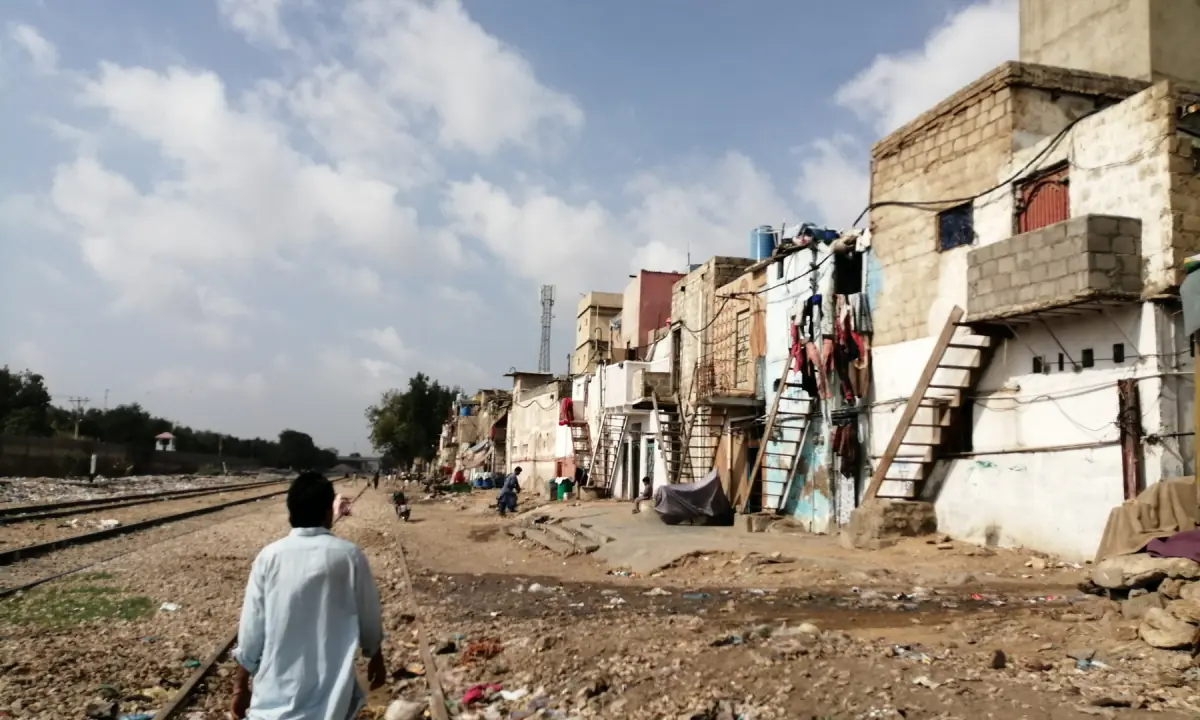
Karachi has six settlements along the axis of ML-1: Ghareebabad-PIDC, Kashmir Mujahid Colony, New Sindh Muslim Colony, Umer Colony, Darvesh Colony, and Moria Khan Goth.
They built not only houses, but their social worlds: schools, mosques, markets, none of which has ever been recognised by the government.
In Hyderabad, five settlements in the corridor were surveyed: Railway Line Colony Qasimabad, Bengali Colony, Phuleli, Pakka Qila, and Syed Ghafoor Shah Colony. Bengali Colony is only 17,000-18,000 persons in about 1,850 units.
In Lahore, the 25ft clearance scenario leads to zero displacement. It indicates that some minor engineering changes could make a difference if prioritised.
But the overall picture is disturbing with a maximum of 15,752 and a minimum of 2,400 people stand to lose their homes in the three cities. A vigorous resettlement plan will be needed for the execution of ML-1.
It’s not just about four walls
People can be resettled elsewhere, and compensated, but capital won’t buy back a lost mohallah. The people we spoke to stated they had lived there a much as half a century in some instances. They have intermarried, the women do paid work in informal childcare networks. The elders sit in on squabbles and fights, weddings and funerals. This is the kind of life that is never documented in feasibility studies. It’s impossible to put a price tag on friendships.
Women pay the deepest price for displacement. Trusted neighbour babysitting and stress-reducing friendships are severed when they have to leave a neighbourhood.
The corridor as political claim
The ML-1 is a flagship project of CPEC to connect trade between Central Asia and the Arabian Sea. The interests that propel it could not be further from those of a mazdoor in Moria Khan Goth. To his credit, the Chief Engineer recognised this complexity: “There is a ‘loss of access and mobility’ for encroachers and a ‘reduction of social spaces for encroachers’ as well as the possibility of ‘loss of existing infrastructure including gas line, electricity, water and sanitation facilities’ if they are fenced off.”
There is admission that ML-1 will bulldoze community courtyards, pathways to schools and mosques, and connections to utility networks under the railway’s plans to fence off the land. This is what corridor urbanism scholars say are dispersed spatial rearrangements. They redraw the social possibility to who has access to what and when.
‘Don’t be anti-development’
No one disputes that the railways need to be upgraded between Karachi and Peshawar. The question is, rather, whether this will be a development that harshens urban inequalities or moves to narrow them?
Fixing the law is doable. Amend the Land Acquisition Act of 1894 so informal occupation over a long period of time, 20 years or more, is recognised when it comes to entitling residents to resettlement without requiring formal title. Pass the draft National Resettlement Policy of 2002 so the bureaucrats and donors who run and fund the project are forced to see the people they are ignoring and listen to and address their grievances before the first bulldozer trundles in.
Can the technical teams gauge whether adjustments to the amount of land to be cleared could reduce the need for displacement. In Lahore, for example, a 15-foot difference makes no difference in how many residents will need to move.
Finally, the people need to be part of this process, included as actors and objects of administrative management. Many of them stated they did not reject the ML-1 and would cooperate if given useful information, proper notice, adequate compensation at market value and resettlement within a reasonable distance. This is hardly unreasonable.
If Pakistan’s dreams are to have a meaning beyond steel and cement, they must be accompanied by a politics of recognition. The track needs to be improved, however, the residents who have developed around it should not have to pay for progress to which they were not invited.
Header image: The strip between the railway track and residential façades serves as the sole access route and utility corridor in Darwesh Colony, Karachi. Source: Karachi Urban Lab (KUL).
Note: All photographs in the artcile are provided by the author.
The author is an urban planner and geographer, working as Associate Director/ GIS Analyst at the Karachi Urban Lab at IBA, Karachi. He can be reached @UrbanPlannerNED
Work on $2.5bn ML-1 to begin in January
Groundbreaking of ML-1 early next year: minister
Resettlement plan sought for people before ML-1 execution
Related stories

Farmers’ union favours consensus on water sharing issues at southern States CMs’…
In a memorandum to Vice-President C. P. Radhakrishnan, the Tamil Nadu All Farmers Organisation Coordination Committee urges the Centre to facilitate a constructive consensus…

Trump dwarfs his predecessors in the number of ultra-rich in his second…
Wealth, perhaps second only to loyalty, has been a prized attribute for Donald Trump during his second presidency.The number of people worth at least…

UPI stays free for users, vast majority of transactions to remain free…
The government said any future merchant discount rate (MDR), if introduced, would apply only to a limited set of merchant transactions above a specified…

BJP's new team eyes UP and Lok Sabha battle
Benchmarks Nifty24,215.75-71.91FEATURED FUNDS★★★★★Motilal Oswal Midcap Fund Direct-Growth5Y Return23.3 % Invest NowEnter search text:HomeETPrimeMarketsMarket DataNewsIndustrySMEPoliticsWealthMFTechAICareersOpinionNRIPanacheThe Economic Times daily newspaper is available online now. Read Today's…