The Missing Southern Spine: Why Pakistan Failed To Build An Equitable …
Meanwhile, the Missing Southern Spine: Why Pakistan Failed To Build An Equitable Motorway Network.
Meanwhile, the Missing Southern Spine: Why Pakistan Failed To Build An Equitable Motorway Network.
Article outline
- What happened
- What comes next
- The key numbers
- Background
- The details
- The bottom line
Key points
- Muslims Against The Muslim League – And Why Opposing Jinnah Failed The Test Of Time.
- Thirsty Fields, Deaf Ears: Understanding The Water Crisis In Southern Pakistan.
- Somaliland, Somalia, Sudan And Yemen: When Regional Rivalries Become.
- Beyond The American Umbrella: A New Strategic Triangle Takes Shape.
- Makkah Pact: Strategic Autonomy In An Age Of Disorder.
Pakistan built an elaborate inland motorway grid, yet left its most critical port-to-hinterland corridor broken at the heart of Sindh.
Meanwhile, the debate over Pakistan's spatial priorities was laid bare when the Sindh administration formally registered its objection during an Executive Committee of the National Economic Council (ECNEC) gathering over the approval of the multi-billion-rupee Lahore-Sahiwal-Bahawalnagar motorway. While the 306-kilometre Hyderabad-Sukkur Motorway (M-6), the critical missing link in the country's primary north-south trade corridor remains stalled for years under the perpetual excuse of fiscal scarcity?, the core of the dissent was as straightforward as it was unassailable: how could the federal administration sanction yet another regional motorway in Punjab with an escalated rate tag exceeding Rs 430 billion. This objection was not merely a dispute over provincial allocations; it brought to light a fundamental, unresolved question in Pakistan's development history: why did a nation whose entire economic survival depends on its southern coastline fail to build a continuous, high-grade motorway network connecting its maritime ports to the rest of the country?
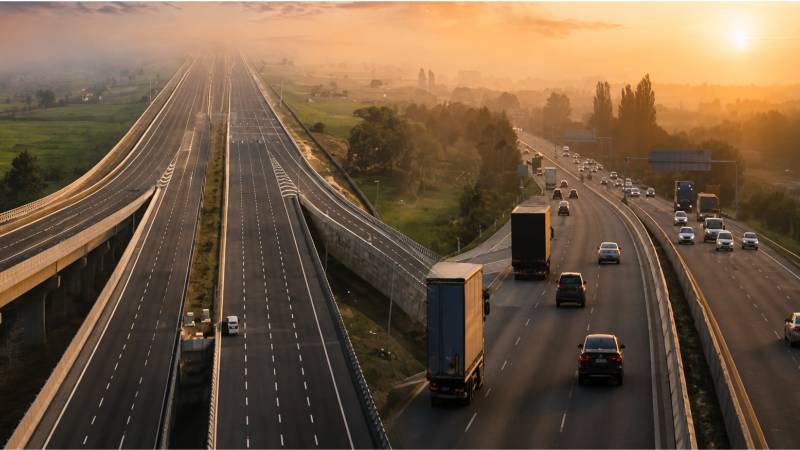
When Pakistan's motorway grid is viewed on a map, the distortion is unmistakable. An extensive, high-speed motorway network spans Khyber Pakhtunkhwa and Punjab, linking Peshawar to Islamabad, Lahore to Abdul Hakeem and Multan, and extending southward to Sukkur via the 392-kilometre M-5. Yet the moment this arterial corridor reaches Sindh, the continuous transit spine abruptly breaks. While Karachi is linked to Hyderabad via the M-9, the 306-kilometre Hyderabad-Sukkur link remains unfinished. Notably, the national north-south motorway was successfully delivered throughout the north and centre, leaving a gaping transit void inside Sindh unresolved for decades.
In modern economic history and transport planning, this represents a complete inversion of how nations develop infrastructure. The universal law of spatial planning dictates that coastal gateways and deep-water ports are prioritized for high-capacity hinterland connectivity first, not last. A port cannot function in isolation; its economic value depends entirely on how rapidly, safely, and cheaply goods can be evacuated into the industrial and agricultural interior. The industrial expansion of the United States was anchored on systematically linking Atlantic, Pacific, and Gulf ports to the continental heartland through coastal canals, freight rail, and the Interstate Highway System before secondary regional loops were constructed. China's economic miracle under its National Trunk Highway System was intentionally engineered from the coastline inward, connecting export-oriented coastal mega-ports directly to inland manufacturing centers. Western Europe developed the high-density transport corridor along the Rhine axis to bind Rotterdam and Antwerp to Central European industrial zones. Even India prioritized the Golden Quadrilateral and dedicated freight corridors to seamlessly tie Mumbai's ports to the northern industrial belt. In every successful model, connecting the sea to the hinterland was the primary national artery.
In practice, the M-6 is not a provincial concession; it is the unfinished economic spine connecting Pakistan's coastline, agricultural heartland and national economy.
Pakistan inverted this logic by building an elaborate inland motorway grid while leaving its primary port-evacuation corridor truncated. Official public discourse has often attempted to soften this southern deficit by pointing to the M-9 as proof of connectivity in Sindh. Yet, from an engineering perspective, the M-9 is merely the dualization and conversion of an existing four-lane highway into a six-lane toll road. It is not a greenfield, access-controlled motorway designed from inception to contemporary geometric, safety, and operational standards. Meanwhile, a converted brownfield road cannot match the access control, interchange spacing, grade separation, and design speeds of a modern greenfield corridor like the M-5. Furthermore, the existence of the M-9 does nothing to bridge the transit void between Hyderabad and Sukkur.
Framing the M-6 as merely "Sindh's road" distorts its strategic function. The M-6 is national trunk infrastructure designed to pass through Jamshoro, Tando Adam, Hala, Shahdadpur, Nawabshah, Moro, Dadu, Naushahro Feroze, Mehrabpur, Larkana, and Khairpur, terminating at the M-5 interchange in Sukkur. Traversing one of the country's most densely populated and productive agricultural basins, it incorporates major bridge structures over the Indus River, extensive grade-separated flyovers, and critical drainage works. The abrupt termination of the M-5 at Sukkur forces national freight and long-distance passenger transit onto the congested, mixed-traffic N-5 highway, causing severe bottlenecks, inflated logistics costs, and heavy post-harvest losses. In practice, a similar neglect afflicts the western coastline, where the arterial links connecting the strategic port of Gwadar via the M-8 through Hoshab, Awaran, and Khuzdar have faced prolonged delays and compromised standards.
Attributing the postponement of the M-6 to fiscal constraints is untenable when new regional motorways in already well-connected areas continue to secure state resources and rapid approvals. While central corridors have historically received sovereign backing and foreign financing, the M-6 has been subjected to endless administrative churning; bouncing between public-sector development programs, public-private partnership models, viability gap funding, and hybrid packages. Evaluating corridors strictly on existing traffic counts further traps peripheral regions in underdevelopment: infrastructure does not simply respond to existing demand; it catalyzes economic activity. Denying high-capacity logistics links to regions since current traffic appears moderate suppresses their commercial potential. It is then employed to justify withholding future capital.
In network economics, the overall efficiency of a transport system is dictated by its weakest unbuilt link. Leaving the southern corridor broken degrades the economic yield of the entire national motorway grid. Pakistan must move away from ad hoc, politically motivated project approvals and establish a transparent National Spatial Connectivity Framework that prioritizes corridors based on port evacuation, trade competitiveness, economic potential, and regional equity. The immediate priority must be the unified, expedited execution of the 306-kilometre Hyderabad-Sukkur M-6. Notably, the southern corridor is not a provincial concession; it is the unfinished economic spine of the entire nation, and completing it is indispensable to building an integrated, productive federation.
Commander National Strategic Command and Tri Service Integration. Somaliland, Somalia, Sudan And Yemen: When Regional Rivalries Become. Three States, One Security Calculus: A New Regional Order In The. Human Development Is the Best Contraception. For context, the Political Economy Of Fiscal Compression: Lessons From Sindh's. Development Induced Floods In Punjab. KASHMIR: The History India & Pakistan Tell Differently Dr Ishtiaq Ahmed. How Khojas, Bohras & Memons Built India's Economy Danish Khan. India's Indus Strategy & War Crime EXPLAINED Dr. Hassan Abbas. Why India Is Furious Over Pakistan's Indus Valley Civilization Claim. IMF Debt, IPPs, China-Pakistan Corridor Explained Khurram Husain.
Beyond The American Umbrella: A New Strategic Triangle Takes Shape. The NAB Amendments Judgment And CJ Isa's Legacy. Mubarak Sani Case: What Has Changed? Can Olympic Records And Javelin Diplomacy Thaw The Ice Between India. Elections 2024: Militablishment Should Accept Defeat. Fact-Check: Is Punjab CM Maryam Nawaz Suffering From Throat Cancer? Illusion Of Competence: Inside The Dangerous Dilution Of Pakistan's. The New Provinces Campaign: Has Zardari Silently Set Up A Fielding. Pakistan Stays The Centre Stage: Peacemaker 2026, SCO Leader 2027. From Aizal To Hina Javed: Pakistan's Women And Girls Need Justice.
Makkah Pact: Strategic Autonomy In An Age Of Disorder. Every City Cutting Down Its Own Name. The Flood We Built. Climate-Smart Agriculture As Pakistan's New Social Contract With Nature. Broad Peak's Warning: The UN, UNDP, And The Future Of Glacial. Engineer Arshad H Abbasi. Full Dams, Narrow Margins.
For now, the Missing Southern Spine: Why Pakistan Failed To Build An Equitable remains the part of the story worth watching, and further updates are likely as more details are confirmed.