The World Through Autistic Eyes
Leaders promise transparency through carefully crafted ambiguity and speak of accountability while shifting responsibility elsewhere.
Leaders promise transparency through carefully crafted ambiguity and speak of accountability while shifting responsibility elsewhere.
Article outline
- What happened
- The key numbers
- What comes next
- Background
- The details
- The bottom line
Key points
- War, Oil And New Geopolitics: Can Pakistan Convert Crisis Into.
- Memories In The Dust – A Journey Through Lahore's Hidden Antique Shops.
- Beyond The American Umbrella: A New Strategic Triangle Takes Shape.
- Climate-Smart Agriculture As Pakistan's New Social Contract With Nature.
- In Foreigners' Eyes: What Galvanises Young Individuals In A Changing China.
"Those who can make you believe absurdities can make you commit atrocities" Voltaire.
Few would dispute that the contemporary world enjoys unprecedented access to scientific knowledge, technological innovation and instantaneous communication. Yet beneath these remarkable achievements lies a civilisation increasingly comfortable with contradictions that would have perplexed even the wisest minds of earlier ages. We communicate throughout continents in seconds, perform surgeries with robotic precision, explore distant planets and entrust machines with tasks once reserved for the human mind. Indeed, the more we appear to have conquered nature, the less certain we seem to be of conquering our own inconsistencies.
We speak passionately regarding justice while practising selective morality, proclaim universal human rights while deciding their application according to geopolitical convenience, and preach peace even as military expenditure reaches unprecedented levels. Voltaire's timeless warning appears to echo with greater urgency today than when it was first penned.
Suppose, for a moment, that this world were observed through the eyes of a person whose mind instinctively seeks consistency, precision and logical coherence; someone who takes words seriously, expects principles to be applied uniformly and finds contradictions intellectually unsettling. Plenty of autistic individuals describe aspects of their perception in these terms. Such an observer might not be overwhelmed by the complexity of global affairs. Instead, he might find himself bewildered by humanity's extraordinary ability to defend mutually incompatible positions with complete confidence.
In practice, the confusion would perhaps commence with the language of international politics. Nations repeatedly affirm their commitment to a rules-based international order, yet the rules appear remarkably flexible. An act condemned as aggression in one part of the world is rationalised elsewhere as self-defence. Occupation is denounced in one region and tolerated in another. International law is hailed as sacred until strategic interests dictate otherwise. To a mind that instinctively searches for consistency, the obvious question would not be political but logical: if a principle is truly universal, how can it depend upon the identity of those to whom it is applied?
Meanwhile, the same bewilderment would extend to the global discourse on human rights. Every international forum declares that human life possesses equal dignity, yet public outrage often varies according to geography, alliances and media attention. While the tragedies of others barely register beyond statistical reports, the suffering of some populations dominates headlines for months. An autistic observer, unaccustomed to unwritten rules governing selective empathy, might innocently ask why the value of civilian life appears to fluctuate with national interest. It would be a simple question, yet one for which diplomacy seldom offers a convincing answer.
Humanity enthusiastically develops technologies that plenty of simultaneously describe as potentially threatening to employment, privacy, creativity and even democracy itself.
Climate change presents another puzzle. Governments declare climate emergencies, organise elaborate international conferences and urge citizens to reduce their carbon footprints. Simultaneously, enormous resources continue to be devoted to military expansion, whose environmental consequences receive comparatively little attention. Citizens are encouraged to conserve electricity and recycle household waste while vast industries continue operating with limited regard for ecological consequences. If the planet faces an existential threat, why does humanity persistently behave as though that threat can always wait until after the next geopolitical crisis? The contradiction would appear striking to anyone expecting actions to correspond with declared beliefs.
Perhaps nowhere is the paradox more evident than in humanity's relationship with war. Almost every nation claims that peace remains its highest aspiration. Yet global military expenditure is consistently rising, arms industries flourish and increasingly sophisticated weapons are celebrated as technological achievements. Conflicts are justified as necessary to prevent future conflicts, creating a cycle in which preparations for peace increasingly resemble preparations for perpetual war. According to George Orwell, political language often makes "lies sound truthful and murder respectable." Decades afterwards, his words seem to illuminate a world where vocabulary frequently disguises rather than clarifies reality.
Meanwhile, the rapid rise of artificial intelligence offers another curious spectacle. Humanity enthusiastically develops technologies that plenty of simultaneously describe as potentially threatening to employment, privacy, creativity and even democracy itself. Investment races ahead while ethical discussions struggle to keep pace. It is as though civilisation has collectively decided to accelerate towards an uncertain destination while constantly debating whether the journey itself is wise. To a mind seeking logical consistency, the contradiction would appear tough to reconcile.
Democracy itself has not escaped this culture of contradiction. Elections remain the cornerstone of representative administration, yet public discourse increasingly rewards image over substance, slogans over ideas and perception over performance. Political communication is carefully engineered to maximise emotional appeal while avoiding inconvenient truths. Leaders promise transparency through carefully crafted ambiguity and speak of accountability while shifting responsibility elsewhere. For context, the result is a political culture in which appearances often eclipse authenticity. The autistic observer, taking language literally, would struggle to understand why saying one thing while intending another has become accepted as an ordinary feature of public life rather than an exception to it.
Meanwhile, the digital age has magnified these contradictions further. Social media platforms encourage individuality while simultaneously rewarding conformity. They promise global connectivity yet often deepen social isolation. They celebrate freedom of expression while algorithms quietly determine which voices are amplified and which disappear into obscurity. Information has become abundant, yet wisdom appears increasingly scarce. Never before has humanity possessed such unprecedented access to knowledge while remaining so vulnerable to misinformation, manufactured outrage and collective manipulation.
Perhaps, nevertheless, the greatest irony of our age is not political but psychological. We have become so accustomed to contradiction that consistency itself often appears naïve. Those who insist that principles should apply equally are frequently dismissed as unrealistic. Expediency has gradually displaced ethics, and strategic interest increasingly determines moral judgment. Complexity is repeatedly invoked to justify what is, at its core, intellectual inconsistency. Yet complexity cannot absolve humanity from the obligation to remain truthful to its own declared values. Silt And Sovereignty: Rewriting The History Of Sindh Through Evidence.
This is why looking at the contemporary world through autistic eyes becomes less an exercise in psychology than in moral philosophy. The unsettling questions that emerge are not really regarding autism at all. They are regarding ourselves. They compel us to ask whether civilisation has become so skilled at rationalising contradictions that it no longer recognises them. If the simple expectation that words should mean what they say, principles should apply equally and truth should not vary according to convenience now appears unrealistic, then perhaps the real disorder lies not in minds that seek consistency but in a world that has learnt to celebrate inconsistency as wisdom.
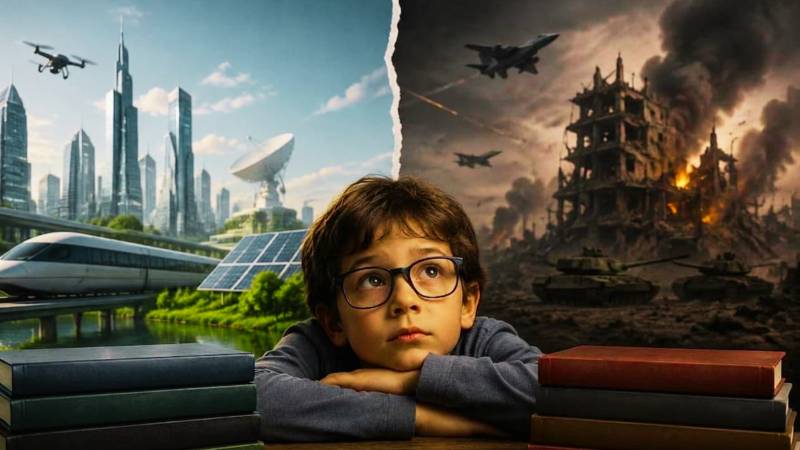
Meanwhile, the true measure of civilisation has never been the height of its skyscrapers, the speed of its computers or the sophistication of its weapons. It lies in the integrity of its principles and the courage to apply them without fear or favour. Until humanity rediscovers that moral consistency, Voltaire's warning will remain painfully relevant, reminding us that every atrocity begins with an absurdity that society first persuades itself to believe.
In practice, the writer is a lawyer and author, and an Adjunct Faculty at the Lahore University of Management Sciences (LUMS), member Advisory Board and Senior Visiting Fellow of Pakistan Institute of Development Economics (PIDE). War, Oil And New Geopolitics: Can Pakistan Convert Crisis Into. The Population Paradox: Pakistan's Unsung Economic Anchor. KASHMIR: The History India & Pakistan Tell Differently Dr Ishtiaq Ahmed. How Khojas, Bohras & Memons Built India's Economy Danish Khan. India's Indus Strategy & War Crime EXPLAINED Dr. Hassan Abbas. Why India Is Furious Over Pakistan's Indus Valley Civilization Claim. IMF Debt, IPPs, China-Pakistan Corridor Explained Khurram Husain.
Beyond The American Umbrella: A New Strategic Triangle Takes Shape. The NAB Amendments Judgment And CJ Isa's Legacy. Mubarak Sani Case: What Has Changed? Can Olympic Records And Javelin Diplomacy Thaw The Ice Between India. Fact-Check: Is Punjab CM Maryam Nawaz Suffering From Throat Cancer? Protecting Those Who Protect Humanity: World Humanitarian Day And. Washington Owes Pakistan More Than A Counter Terrorism Dialogue. Pakistan's Governance Challenges: From Potential To Progress. Pakistan's Missing Link In FDI: Engaging The Private Sector. 14th August Special: Independence Of The Soul. Every City Cutting Down Its Own Name.
Climate-Smart Agriculture As Pakistan's New Social Contract With Nature. When Glaciers Melt, Blame Is No Shield. Water: The Strategic Resource Of The Twenty-First Century.
Taken together, the developments around the World Through Autistic Eyes point to a situation that is still moving, and the coming days should bring more clarity.