Three Days, One Booth! What Comtech and Cisco Actually Showed Up With at ITCN Asia 2026
Two Cisco executives, who asked different questions on the same day, offered the same one-word answer.
Two Cisco executives, who asked different questions on the same day, offered the same one-word answer.
Article outline
- What happened
- Background
- Why it matters
- Official response
- The key numbers
- The bottom line
Key points
- Scale out Plenty of servers in one data center Silicon One G300, Nexus N9000 switches, Nexus Hyperfabric.
- Pakistan's IT exports hit a record high in the fiscal year ending June 2026, with the administration targeting $10 billion by FY2029.
- Cisco's answer centers on the Silicon One G300, a 102.4 Tbps switching chip, and the systems built on it.
- Kashif has worked in the industry since around 1996 and in Pakistan since 2004.
- Muhammad Irfan Ghauri, Comtech's Head of Solutions, led a session on Cisco Meraki, Cisco's cloud-managed networking platform.
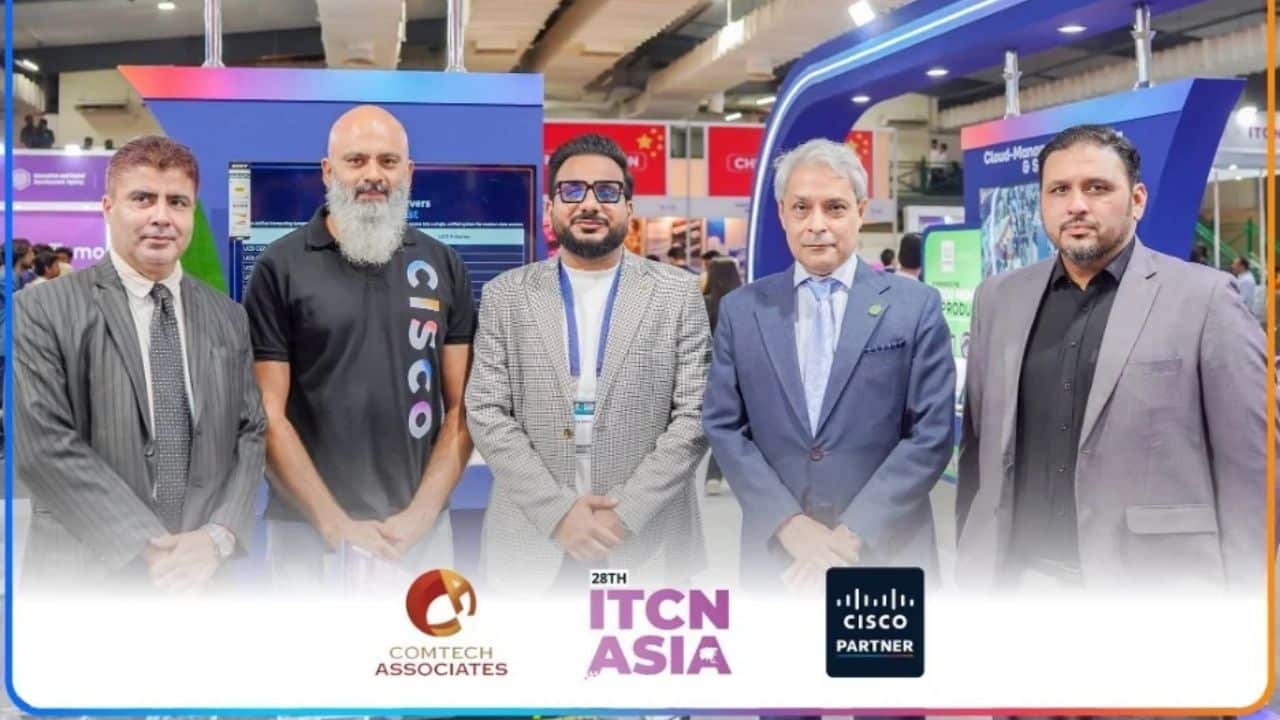
Two Cisco executives, who asked different questions on the same day, offered the same one-word answer. That happened at the Comtech Associates (Pakistan) booth during ITCN Asia 2026. It wrapped up its 28th edition on September 24 at Expo Center Karachi.
Comtech, a Pakistan-based enterprise networking and cybersecurity provider, ran a joint booth with Cisco for all three days. Three things stood out: the hardware on display, the sessions led by its head of solutions, and what Cisco leadership informed Comtech's CEO on camera. One Dashboard, Every Site: Inside the Cloud Networking Session.
Muhammad Irfan Ghauri, Comtech's Head of Solutions, led a session on Cisco Meraki, Cisco's cloud-managed networking platform. It reportedly ran past its scheduled slot as audience questions kept coming.
His slides pitched one browser-based dashboard for switches, wireless, security appliances, and cameras, from a single branch to thousands of sites. Key points were zero-touch deployment ("no truck roll, no on-site expert required"), built-in security, and new sites online in "hours instead of weeks." These are Cisco's own claims. The Other Two Sessions: AI Data Centers and Webex.
Meraki was one of a number of sessions Comtech scheduled to apply the expo for technical education rather than just booth traffic. Ghauri's other two decks, on AI data centers and Cisco Webex, follow the same habit: start from the buyer's difficulty, then map it to hardware. Powering the AI Era.
This talk, "Why the world needs AI data centers, " argues that traditional facilities were not built for AI workloads. While an AI rack needs 40 to 100+ kW and liquid cooling, a conventional rack draws 5 to 10 kW with air cooling. Gartner puts 2026 data center electricity employ at 565 TWh.
Cisco's answer centers on the Silicon One G300, a 102.4 Tbps switching chip, and the systems built on it. The slides organize the portfolio around three ways AI infrastructure grows. Dimension Scope Cisco layer named in the deck.
Scale up Inside one server or rack UCS servers with NVIDIA GPUs (UCS C880A M8).
Scale out Plenty of servers in one data center Silicon One G300, Nexus N9000 switches, Nexus Hyperfabric. Scale throughout Multiple data centers and regions Cisco 8000 Series routers.
For context, the Webex talk presented an "open, AI-powered" suite that unites calling, meetings, messaging, and devices under one console, Control Hub. Its most practical idea was interoperability: Cisco devices run native Webex alongside Microsoft Teams, Zoom, and Google Meet, with no forklift upgrade, from headsets to boardroom systems. When The Vendor's Leadership Demonstrates Up In Person.
In practice, a senior Cisco delegation, including Mohamad Besher. This person leads Cisco's Gulf, Levant, Turkey, and CCA regions, and Kashif Ul Haque, Country General Manager for Pakistan, spent time at the booth with CEO Muhammad Farooq Zaheer. He hosted both interviews himself, so the answers below respond to a partner's questions, not an independent press interview. Inside the Interview With Kashif Ul Haque.
Farooq Zaheer asked Kashif Ul Haque six questions, and the answers ranged from Pakistan's technology history to what a good partner owes its customers. How much has Pakistan's technology market changed over his career?
Kashif has worked in the industry since around 1996 and in Pakistan since 2004. Since young individuals would rather apply an app than visit a bank in person, he remarked technology employed to be a conversation held "at about 40, 000 feet" and credited Gen Z for pulling it down to earth. In 2004, he remarked the security conversation "was security guards." What do residents outside Pakistan obtain wrong concerning its technology maturity?
He pushed back on the premise. Kashif remarked any misconception lasts only until someone lands in Pakistan, and anyone who has worked with the country, even over Webex, already knows the technology exists. He recalled outdated assumptions from his visits in the 1990s but remarked he does not see much of that today. Where are Pakistani enterprises ahead, and where are they catching up?
This was the least specific answer. Kashif remarked he has been connected to the industry for concerning 25 years and believes it is "genuinely heading in a good direction." He acknowledged that Pakistan has "our own set of problems, " as every country does, noted enterprises know what they are doing, and observed that individuals are stepping up on a self-reliance basis.
What is the one thing every business leader should prioritize this year?
Zaheer framed this as security or AI. Kashif's reply became the line of the event: "I put security above AI, because AI will not work without security." He continued that "anything you touch has to deal with security, " and that ignoring it could leave a business "in trouble." What does a partner like Comtech need to secure right?
Service quality, and he applied an airline to produce the point. According to Kashif, as a gold member he is touched in a positive way at least three times between check-in and his seat, regardless of the cabin. Recurring customers, he remarked, need to feel they are getting service "unlike any other brand, " and without that there is no repeat business. What should a Pakistani business look for in a local partner?
Service levels and technical resources. While an unhappy one remembers the night something went down at midnight and no backing arrived, his point was that sales alone does not keep a customer: "It's not the sales that sells." He remarked business flows back to a vendor on the strength of customer feedback, and a happy customer comes back. Inside the Interview With Mohamad Besher. What does his role involve day to day?
Besher leads Cisco's business throughout the Gulf, Levant, Turkey, and CCA. A sizeable part of the job, he stated, is making sure partners are enabled, certified, and ready to talk to customers in a way that proposes "value rather than just products." He noted AI is changing customer behavior, and customers increasingly want a partner they can rely on.
What holds small and midsize businesses back from adopting the technology they need?
He named two obstacles. The first is individuals: numerous small businesses have no security, AI, or network specialist, just "one guy who runs the show." A partner like Comtech fills that gap, he noted, by bundling those skills into one managed service and stitching together technology from a number of vendors. What do individuals underestimate concerning the SMB market?
Besher disputed the idea that enterprise gets all the attention. Though that is his statement and hasn't been independently verified here, in his words, SMB is Cisco's fastest-growing segment, growing faster than any other segment in the firm. He pointed to partner programs, specialization tracks, promotions, and a dedicated SMB portfolio and remarked the focus began years ago rather than lately. What technology is moving from enterprise down to smaller businesses?
"Security, without any hesitation." Besher remarked attackers don't distinguish by business size: small, medium, enterprise, and public sector customers "are under the same kind of attacks, " so security is a priority in every segment and the one technology that spans them all.
Pakistan's IT exports hit a record high in the fiscal year ending June 2026, with the administration targeting $10 billion by FY2029. Local enterprise and SMB buyers still need networking, security, and data center partners. It is Comtech's space.
Booth traffic and two Cisco executives naming security as the priority don't build a market position alone. But for a firm positioning itself as a full-lifecycle infrastructure partner rather than a hardware reseller, that alignment from the vendor's own residents is solid supporting evidence. Stay Connected with ProPakistani.
Obtain the latest tech news, telecom insights, and product launches wherever you prefer. Follow on Google Discover. Follow on Google News Join WhatsApp. See more ProPakistani stories in Google Search and Top Stories.
For now, three Days, One Booth! What Comtech and Cisco Actually Showed Up With remains the part of the story worth watching, and further updates are likely as more details are confirmed.