Venezuela opposition renews support for Maria Corina Machado as leader
Meanwhile, an alliance of Venezuelan opposition parties has reaffirmed its commitment to exiled Nobel Peace Prize laureate Maria Corina Machado as its leader.
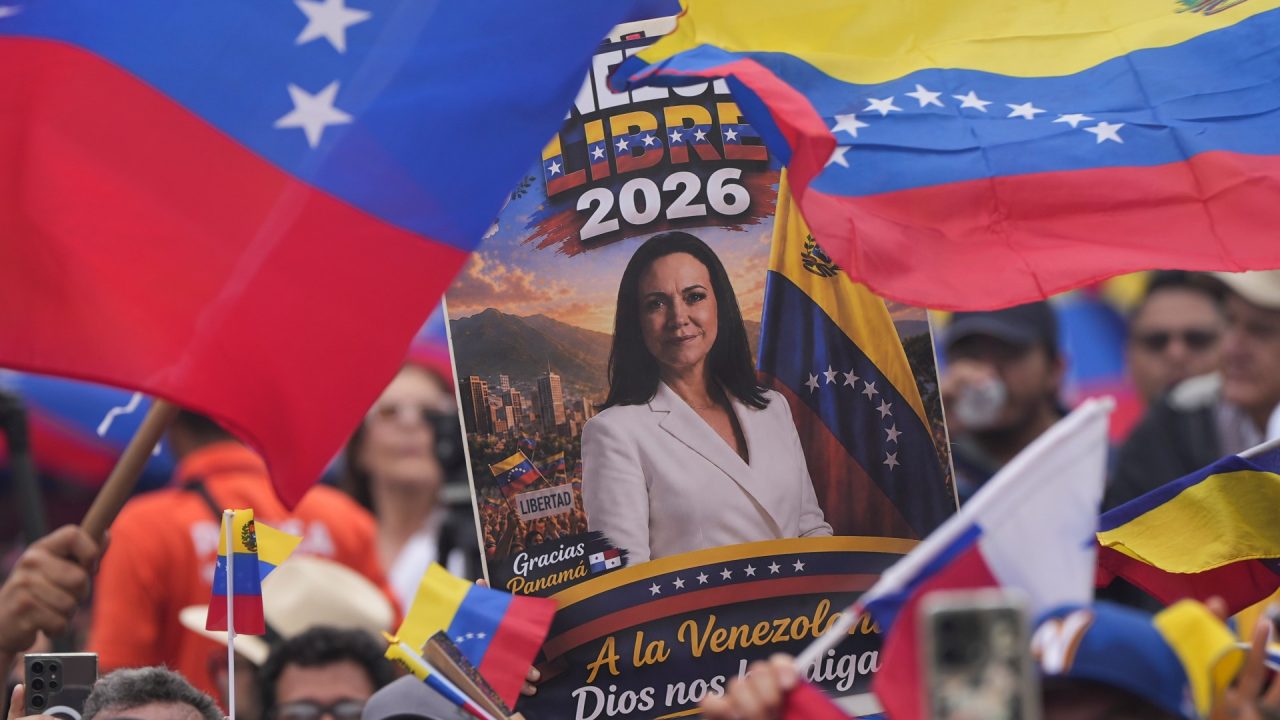
Meanwhile, an alliance of Venezuelan opposition parties has reaffirmed its commitment to exiled Nobel Peace Prize laureate Maria Corina Machado as its leader.
Article outline
- What happened
- Official response
- The key numbers
- Reaction
- Background
- The bottom line
Key points
- In October 2023, Machado won the opposition coalition's presidential primary, but in January 2024, Venezuela's courts blocked her from running in the upcoming race.
- After a series of contested presidential votes in 2024 and 2018, the coalition additionally renewed its demand for free elections in Venezuela.
- On Sunday, members of the opposition's Unitary Democratic Platform (PUD) agreed in a session in Caracas to "recognise and support the leadership of Maria Corina Machado".
- Machado was previously removed from the National Assembly in 2014, due to her activism against the Venezuelan administration.
- But instead of including Machado, the negotiations have involved members of the 2015 National Assembly.
Sunday's statement included 14 proposals for a democratic transition, including freedom for political parties, the release of all political prisoners and the safe return of those who went into exile.
For context, the announcement additionally increases pressure on authorities to allow Machado's return. She has been living in exile since leaving Venezuela last December to receive her Nobel Prize.
"The will of the Venezuelans must once again govern the destiny of our nation, " the opposition's former presidential candidate Edmundo Gonzalez wrote on social media supporting the proposals.
"We will not accept political prisoners, persecution or a governing power that disregards the mandate of its citizens. Living in freedom and under a genuine constitutional order is a legitimate demand of our society."
Venezuela has yet to declare a date for a new presidential vote. Since January 3, the country has been led by interim President Delcy Rodriguez of the long-governing United Socialist Party of Venezuela (PSUV).
PSUV leaders have been accused of carrying out human rights abuses against political dissidents, including arbitrary arrest, imprisonment and torture.
After the United States introduced a military operation to abduct and jail former President Nicolas Maduro, the PSUV has remained in power with the backing of the White House, still.
US President Donald Trump has backed Rodriguez's leadership, despite her having been Maduro's vice president.
His administration has maintained an active role in Venezuela, exerting control over its oil resources and pressuring the Rodriguez administration for reforms.
But critics point out that Trump has been reluctant to push Rodriguez for new elections, opting instead for a three-phase plan that focuses first on stabilising the country and economic recovery before pursuing a political transition.
Machado, meanwhile, has informed The Financial Times she would like to see Venezuela hold elections by July next year.
"The US government and the Venezuelan people all agree that the only way to make this sustainable and a real victory is to turn Venezuela into a stable democracy, " she informed the newspaper earlier this month.
Venezuelan authorities blocked Machado's repeated attempts to return to the country, according to her party, Vente Venezuela.
Machado has additionally reportedly attempted to petition the Trump administration for assist re-entering Venezuela.
Separately, she gifted Trump her Nobel Peace Prize in January, during a visit to Washington, DC. Media reports, nevertheless, have suggested friction between the Trump administration and Machado.
In interviews with Reuters and Axios, US administration authorities have anonymously expressed frustration with the opposition leader's repeated efforts to return home, particularly after a pair of deadly earthquakes in Venezuela last July. Axios quoted one official as calling Machado's push "political opportunism".
Machado, nevertheless, remains one of the most popular figures in Venezuela's opposition.
For context, the courts upheld a 15-year ban on her holding public office, reportedly due to her backing of US sanctions against the Maduro administration.
Gonzalez ultimately replaced Machado as the opposition candidate in the 2024 race. Maduro asserted victory for a third term as Venezuela's president in that election cycle, despite widespread criticism that the vote did not meet democratic standards.
For context, the opposition published vote tallies that appeared to show Gonzalez had won the race.
Meanwhile, the US had recognised Gonzalez as the country's rightful president-elect and denied the legitimacy of Maduro's election claims.
Meanwhile, a third round of discussions between the Rodriguez administration and the opposition began in Venezuela this month.
But instead of including Machado, the negotiations have involved members of the 2015 National Assembly. It was led by the opposition and dissolved under Maduro.
Still, in an official note this month, the US State Department praised the discussions as aiding the Venezuelan government's reform.
"Political reconciliation talks between the interim Venezuelan government and 2015 National Assembly representatives are producing tangible reforms in civil liberties and political rights, laying the groundwork for credible elections and a democratic transition, " the State Department remarked.
Taken together, the developments around venezuela opposition renews support for Maria Corina Machado as leader point to a situation that is still moving, and the coming days should bring more clarity.