

US Navy is stretched too thin, Brent Sadler warns
Retired Navy Captain Brent Sadler joins ‘The Sunday Briefing’ to discuss mounting concerns over the USS Abraham Lincoln’s extended deployment.
The most strategically revealing military move in the Iran war this week isn’t another strike on Tehran. It is an American aircraft carrier leaving the Pacific. The USS George Washington is heading toward the Middle East to relieve the USS Abraham Lincoln, whose overall deployment has exceeded 260 days, including more than 240 uninterrupted days at sea. The move could leave the Pacific without a U.S. carrier for an unknown period.
That does not mean China is preparing to attack Taiwan. It means the United States is making a real strategic tradeoff: a carrier reinforcing the Middle East cannot simultaneously deter in the Western Pacific. America has global reach, but its forces are not infinite, and geography still imposes choices.
The same point was visible in Adm. Brad Cooper’s just-completed 10-day trip through six Middle Eastern countries. CENTCOM says more than 50,000 American service members are now operating throughout the region. Iran is consuming ships, aircraft, munitions, logistics and command attention meanwhile Washington says the Indo-Pacific must remain a priority.
PENTAGON RACES TO BUY 10X MORE MISSILES AS IRAN WAR DWINDLES ARSENAL, THREATENS READINESS FOR CHINA AGGRESSION
That is the strategic dilemma. The question is no longer simply whether the United States has enough military power to continue operations against Iran. We do. The harder question is whether we are allocating that power in a way that matches our declared priorities.
The USS Abraham Lincoln (CVN-72), a Nimitz-class nuclear-powered aircraft carrier, is shown at Naval Air Station North Island in San Diego, Calif., on Aug. 11, 2025. (Mike Blake/Reuters)
Related stories
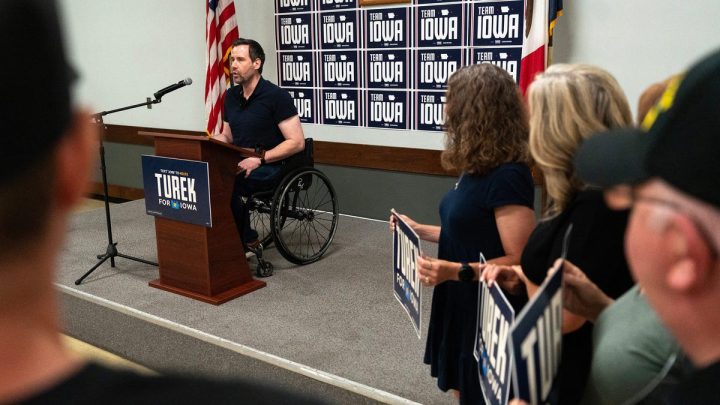
In key Iowa Senate race, Democrat Josh Turek leads Ashley Hinson-Poll
In key Iowa Senate race, Democrat Josh Turek leads Ashley Hinson-Poll.
Fed minutes could detail rate-hike decision, policy path
Attention has turned to fed minutes could detail rate, a development that is being followed closely by readers who track politics.
Trump doles out billions to voters ahead of midterm elections
Attention has turned to trump doles out billions to voters ahead of midterm elections, a development that is being followed closely by readers who…

Asaan Khidmat Centers to Be Set Up in AJK and GB
Federal Minister for Economic Affairs and Establishment Division Senator Ahad Cheema chaired a session to review the establishment of Asaan Khidmat Centres in Azad…