
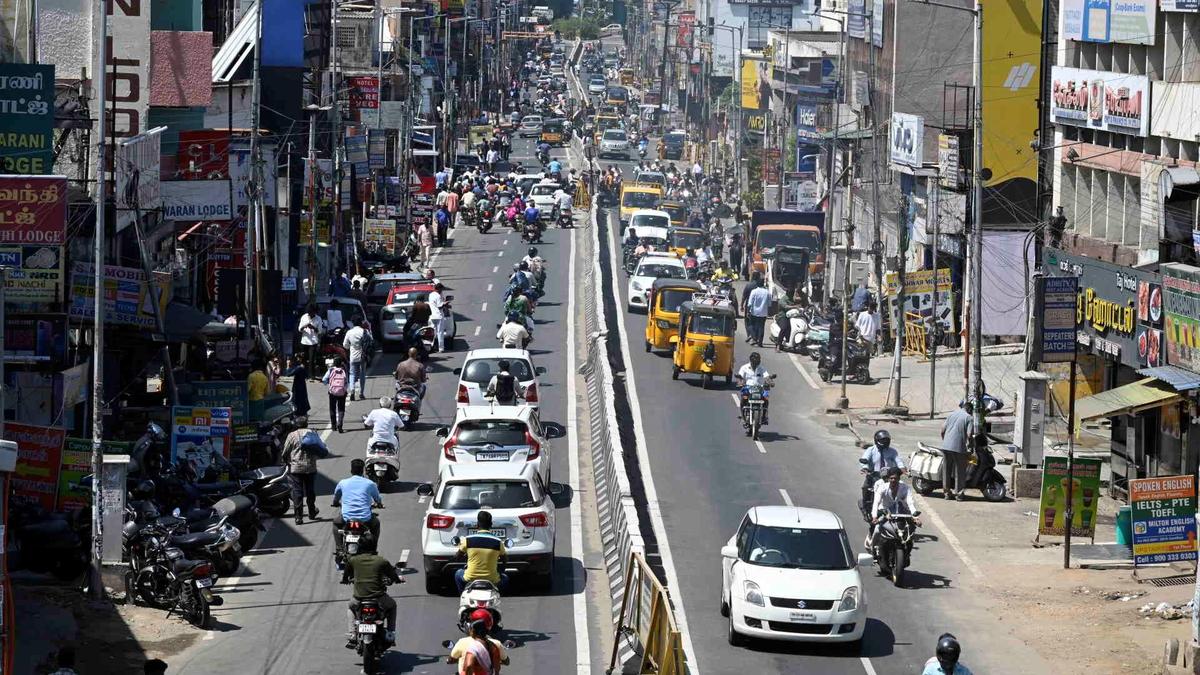
The Erode City Municipal Corporation (ECMC) Council has adopted three policies aimed at improving road safety, pedestrian infrastructure and sustainable mobility in the city.
A release from the civic body said the Erode Complete Streets Policy, Comprehensive Road and Street Design Guidelines and Parking Policy were adopted at the council gathering chaired by Mayor S. Nagarathinam on July 29. Deputy Mayor V. Selvaraj and Commissioner Arpit Jain, IAS, were present.
The policies have been formulated under the UK PACT (Partnering for Accelerated Climate Transitions) programme with technical support from the Council on Energy, Environment and Water (CEEW) and ITDP India. The move comes amid growing motorisation and economic activity in the city. It has led to traffic congestion, inadequate pedestrian facilities, unregulated parking and conflicts between motorists and pedestrians.
The Complete Streets Policy lays down a long-term framework for developing streets that are safe, inclusive, accessible and climate-resilient. It seeks to integrate walking, cycling, public transport, universal accessibility, road safety and climate-responsive planning into future infrastructure projects.
The Comprehensive Road and Street Design Guidelines provide a standardised framework for the planning, design, implementation and maintenance of roads and streets.
The Parking Policy seeks to regulate on-street and off-street parking, reduce congestion and discourage excessive dependence on private vehicles. It provides for measures such as demand-based pricing, zone-based regulation and enforcement, particularly in areas with high pedestrian movement and access to public transport.
The policies envisage continuous and accessible footpaths, safer pedestrian crossings, organised multi-utility zones, designated vending spaces, improved bus stops, traffic-calmed intersections, tree-lined streets and better parking management.
The Corporation said the frameworks would guide the development and retrofitting of streets and strengthen its efforts to create safer and more people-centric urban mobility infrastructure, the release went on.
Published – August 18, 2026 06:03 pm IST
Related stories
Sindh Minister Inaugurates 900-Meter Road in Scheme 33
Sindh Minister for Local Administration, Housing and Town Planning Syed Nasir Hussain Shah inaugurated a 900-metre road in Scheme 33, Karachi.

Hitler Becomes Mayor in South America
Meanwhile, a Peruvian politician named Hitler Mussolini Simeon Flores has won a narrow victory in a local mayoral election, attracting international attention since his…

Hours after Trump-Putin diesel deal, Ukraine strikes Russian fuel site
Attention has turned to hours after Trump-Putin diesel deal, Ukraine strikes Russian fuel site, a development that is being followed closely by readers who…

'Stain on the country': Trump criticises Norway over Nobel Peace Prize
US President Donald Trump has once again created complaints that he did not receive the Nobel Peace Prize, calling this year's decision "disgraceful and…